
The first ten B2B customers determine what the company becomes: their problems become the roadmap, their willingness to pay becomes the pricing, and their logos become the Series A deck. The documented pattern across startup postmortems and sales leadership writing is consistent — companies that selected these customers deliberately built repeatable motions, and companies that took whoever said yes spent years unwedding themselves from outlier requirements. This is a playbook from the documented record, not consulting advice. Honey Badgers publishes information, not professional advice.
What is a design partner, actually?
A design partner is an early customer who accepts an unfinished product in exchange for influence over it — typically at a discounted price, with a documented feedback cadence, and with an explicit agreement that the customer's team will spend real time with the startup. The distinction from a normal early customer is the contract's spirit: a customer buys what exists; a design partner buys what will exist and helps build it. The documented failure mode is the label without the deal — customers called 'design partners' who in fact wanted a finished product cheap, gave no feedback, and churned in month four. The counter is contractual: written feedback sessions, named internal stakeholders, and a defined pilot with success criteria.
How do you find the first ten?
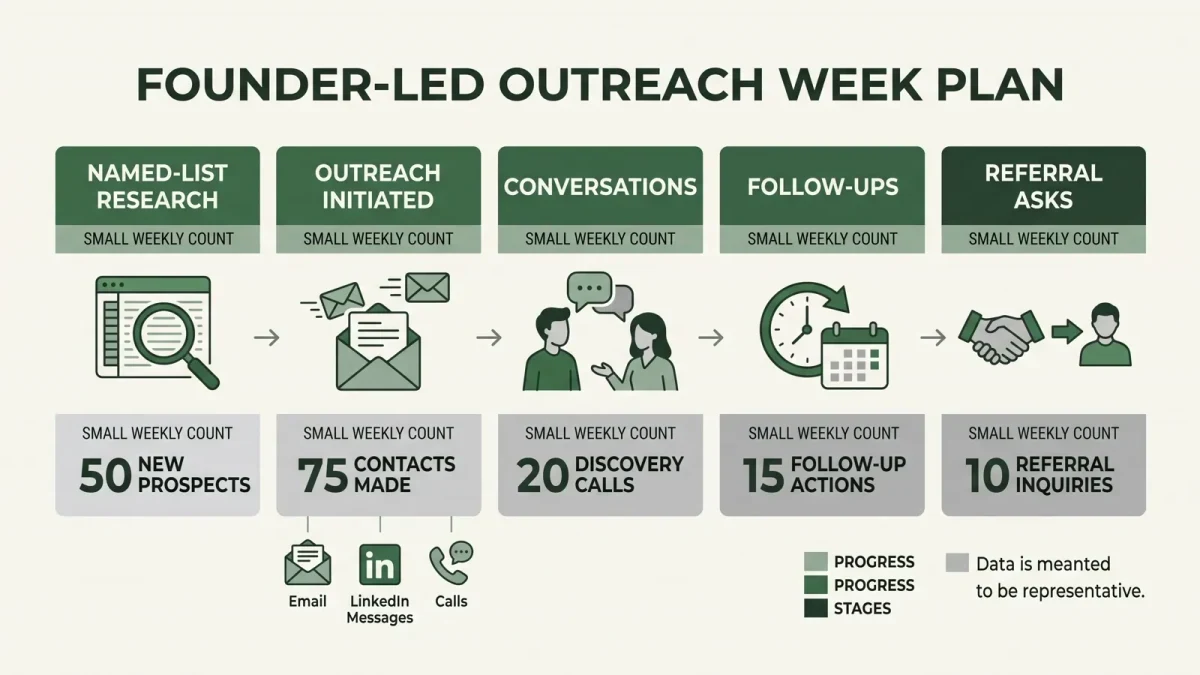
The documented channels, in descending order of conversion: founder networks and warm referrals, which produce the majority of first customers at most B2B startups per founder survey data; targeted outbound to a hand-built list of 100-200 profile-fit companies, which produces the rest; communities where the buyer's practitioners gather; and inbound from narrow technical content, which compounds slowly. The selection filter matters more than the channel: the ideal profile is a company with the problem painfully, budget authority held by someone reachable, technical maturity to tolerate a young product, and a name credible enough to signal the market. Founders should reject early money that violates the profile — the first customer who forces an on-premise deployment for a cloud product has just set product strategy for a company of eight people.
What should you charge?
Something. The documented pattern is a paid pilot — discounted, time-boxed, with a success metric and an expansion conversation scheduled at the end. Free pilots convert terribly: the postmortem and sales literature agree that a customer paying nothing retains the right to ignore the product, and usage data from unpaid deployments underpredicts paid behavior dramatically. The working structure: an annual contract at a meaningful discount, prepaid quarterly if possible, with the discount explicitly traded for case-study rights, reference calls, and a feedback cadence. Price discovery is the hidden value of the first ten — the number where prospects stop saying yes tells the founder more than any survey.
How do you run the feedback loop without building ten one-offs?
Three disciplines from the documented practice. Roadmap arbitration in writing: every request logged, every acceptance justified against a stated product thesis — the founder's one-sentence definition of what the product is, which makes 'no' cheap. The 80 percent rule: features requested independently by three or more design partners graduate to the roadmap; anything else is bespoke work sold at services pricing or declined. And a shipped-versus-requested review each quarter: if more than a minority of shipped work traces to a single customer, the company is becoming a consultancy with a cap table — the documented trap that killed many otherwise promising B2B startups of the 2015-2020 vintage.
When do you graduate from design partners to repeatable sales?
The observable graduation signals, per the record: prospects you did not design-partner begin closing at similar prices without founder-led customization; the sales conversation repeats — the same problem statement, the same demo path, the same objections; and retention holds across cohorts not hand-selected by the founder. The typical sequencing: design partners one through ten build the wedge; customers eleven through thirty, sourced colder, validate repeatability; and the sales hires that follow inherit a documented motion rather than improvising one. Hiring a sales team before the motion repeats is the classic scaling error — the 2021-2022 vintage documented it at scale, with burn multiples blowing out on sales teams that had nothing repeatable to sell.
The first ten customers are the company's apprenticeship. Choose the teachers deliberately, charge them something, and keep the product thesis — not the loudest logo — in charge of the roadmap.