The most common advice given to first-time founders — get a co-founder, investors demand it — is backed by data that is real, repeatedly documented, and consistently over-quoted. Co-founded companies raise more and fail less on average; solo founders who succeed keep more and move faster. The base rates support both configurations, and the documented gap between them is smaller than the folklore says, while the cost of the wrong co-founder is larger than either. This is an analysis of the record, not advice about any company. Honey Badgers publishes information, not professional advice.
What do the base rates actually show?
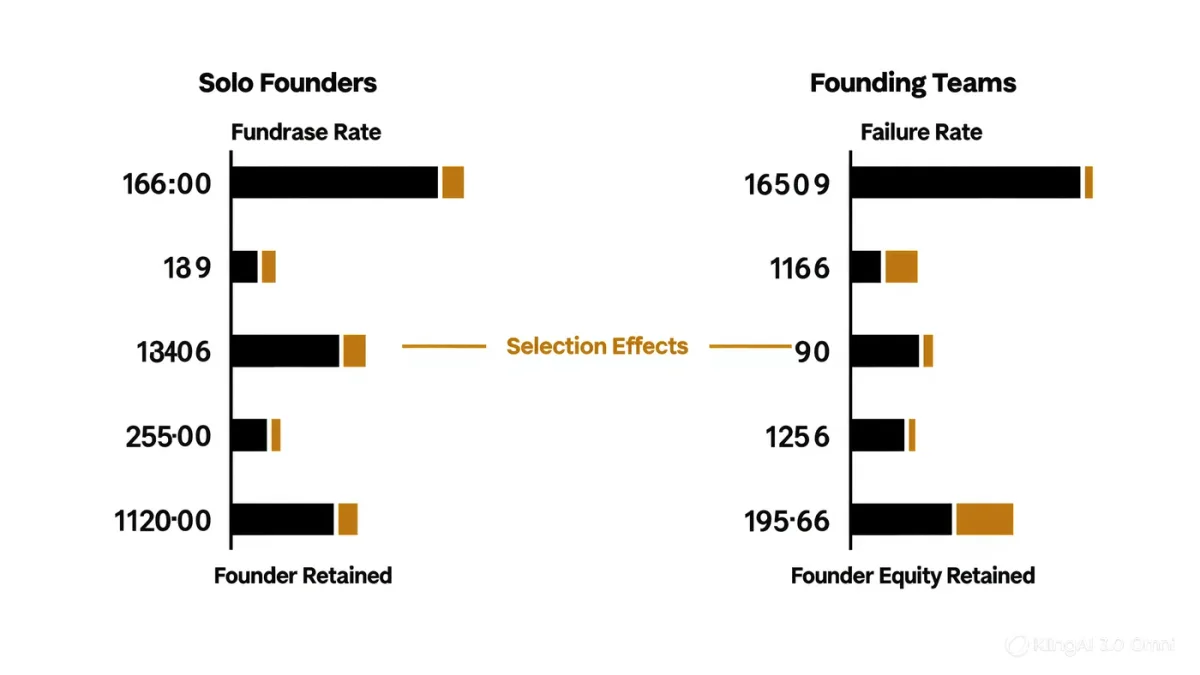
The documented patterns from venture data and academic studies: co-founded teams raise seed and Series A at higher rates — the commonly cited gap is meaningful, with solo-founded companies a minority of venture-funded deals; failure rates at the venture-backed level are lower for teams, attributed variously to complementary skills and shared load; and solo founders who do raise perform comparably on outcomes — the survival difference narrows once funding is secured, suggesting much of the gap is investor selection, not company quality. The honest reading of the selection effect: investors screen for teams partly because teams are legible — a two-founder company demonstrates someone else vetted the founder — so the base-rate advantage is partly an artifact of the market's preference, which the market can change. Notably, solo-founded share of top outcomes is far from zero: a material share of the largest company outcomes of the past two decades were founded solo, from Amazon to numerous modern AI companies.
What are solo founding's documented advantages?
Speed and coherence: no co-founder negotiation on product, hiring, or pace — decisions move at the founder's clock, and the documented drag of co-founder conflict, the leading proximate cause of early-stage failure cited in postmortems, is structurally absent. Equity integrity: 100 percent at formation means no 50/50 deadlock, no divorce litigation, no cap-table archaeology at the Series A. And the modern mitigation stack: the load-sharing arguments against solo founding — no one to cover sales while you build, no one to sanity-check at 2 a.m. — are addressed by the fractional-executive market, the advisor stack, and AI tooling that has documented, in the 2024-2026 era, small teams shipping at headcounts that would have required co-found-level capacity a decade earlier.
What are the documented risks of solo founding?
The real ones, from the postmortem record: the diligence-adjacent problem — investors' preference for teams means a solo founder runs a slower, harder fundraise, and the founder must compensate with unusual evidence or unusual credibility; the board problem — a solo founder's only senior colleagues are investors and hires, both with different principal-agent structures than a co-founder, and the loneliness-to-bad-decisions pipeline is documented in founder mental-health research; and the bus-factor problem, which insurers, acquirers, and enterprise customers price in during diligence. Each risk has a documented mitigation — early executives with real equity, a strong board, founder communities — and each mitigation costs more than a co-founder would have.
When is a co-founder clearly the right call?
Three documented cases. Complementary hard skills with symmetric commitment: one builder, one seller, both full-time, both founder-tier — the configuration the base rates actually reward. Deep-tech and hardware: the capital intensity and multi-disciplinary surface (research, engineering, regulatory, manufacturing) exceed any single founder's bandwidth in the documented record — the AI-lab founding teams of 2024-2026 are all multi-founder. And prior-relationship depth: co-founders with years of shared history — colleagues, co-founders before — show lower documented conflict rates than assembled teams; the founding team that met at a hackathon last month is the configuration the graveyard is full of.
What is the wrong reason to take a co-founder?
To satisfy the market. The documented failure pattern: a solo founder, told investors require teams, recruits a co-founder at the deadline — title without alignment, equity without earned trust — and spends the next two years managing a partnership that was never a partnership. The co-founder conflict literature is unambiguous about the ordering: relationships precede ventures or the ventures precede their failure. The market's team preference, meanwhile, is softening at the edges: the 2024-2026 vintage documented solo technical founders raising seed rounds on the strength of shipped work, particularly in AI, where a single builder's output is unusually demonstrable.
The base rates say: teams raise easier, solos keep more, and both configurations reach the top of the distribution. The choice the data actually prices is not one founder or two — it is a founding configuration chosen deliberately, or defaulted into under advice that quoted the base rates without reading them.