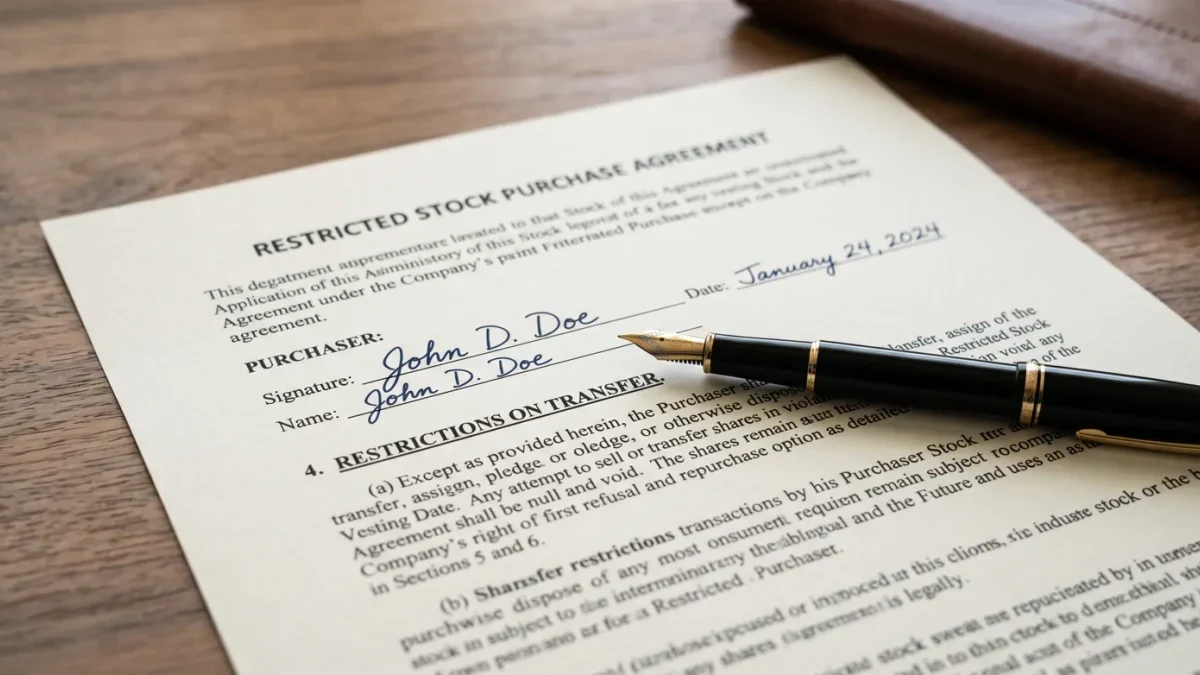

Founder vesting is a schedule under which founders earn their equity over time — standardly four years with a one-year cliff, meaning a founder who quits in month ten owns nothing, and one who stays four years owns their full stake. It is the least negotiated and most litigated term in company formation, because it decides what happens on the day a co-founder relationship breaks. Honey Badgers publishes information, not legal advice; every specific term below is a market norm, not a rule, and founders should get counsel before signing anything.
How does the standard schedule actually work?
Four years, one-year cliff, monthly or quarterly thereafter: a founder with 40 percent of a company vests 10 percentage points at the one-year mark, then roughly 0.83 points monthly for the next 36 months. The cliff exists to solve the free-rider problem — the co-founder who contributes for three months and leaves with a founder-sized stake is the oldest horror story in the industry. What vesting technically means is a repurchase right: the company can buy unvested shares back, normally at the original nominal price, so the departed founder's unvested equity returns to the pool.
Do founders vest even without investors?
They should. Vesting among co-founders is a mutual agreement set at formation, before any outside money, and the market norm — confirmed across venture surveys — is that essentially all institutional investors will require it at the first priced round regardless. Two founders who split equity 50/50 unvested at incorporation and raise a Series A eighteen months later will be re-vested by the term sheet: the investor applies a fresh four-year schedule to everyone, usually with credit for time served only if negotiated. The founders who skipped vesting at formation thus negotiate it later, with less leverage, tired.
What is acceleration and when does it trigger?
Acceleration clauses vest some or all unvested equity early on defined events. Single-trigger acceleration vests a portion — commonly 25 to 50 percent — on termination without cause or a change of control; double-trigger requires two events, typically an acquisition plus termination without cause within a window, and is the market standard for executives. Double-trigger protects the acquired employee fired 90 days post-close; single-trigger in quantity can scare acquirers, who price the unvested equity they planned to use as retention into a lower offer. Founders negotiating acquisition terms should model both sides of that trade before insisting on either.
How does vesting interact with 83(b) elections?
In the U.S., founders purchasing shares subject to vesting can file a Section 83(b) election within 30 days of purchase, taxing the shares at their near-zero founding value instead of at each vesting date's appreciated fair market value. Miss the 30-day window and the founder owes income tax on every vesting tranche as it vests — at market prices, which at a successful startup means unpayable taxes on paper gains. This is the single most expensive paperwork deadline in founder finance, it is unforgiving by statute, and it applies to restricted stock at formation, not only to option grants.
What exceptions and renegotiations actually happen?
The record of practice shows four recurring moves. Re-vesting at a new round — investors reapplying schedules to founders, as above. Vesting extensions as an alternative to firing — a struggling founder moved to a smaller role keeps some equity under an extended schedule rather than a cliff-edge departure. Good-leaver/bad-leaver distinctions in European and Asian deals, where the repurchase price of unvested shares depends on the departure's circumstances. And the founder who vesting quietly punishes: the one who did the early work, took a diluted stake, and must still serve four years from the funding date for equity they arguably earned before incorporation. Each is solvable at formation with honest drafting, and nearly unsolvable afterward.
What should co-founders agree on at formation?
A short list, in writing: identical vesting schedules for all founders, with time-served credit if the company existed informally before incorporation; a cliff that both protects against free-riding and acknowledges contribution asymmetry; double-trigger acceleration for everyone; 83(b) filings calendared within 30 days; and an explicit, even uncomfortable, conversation about what happens if one founder stops performing in year two. The standard four-and-one schedule is not sacred — some teams front-load or use five years — but whatever the schedule, it must be the same law for every name on the cap table, including the CEO's.
Vesting is the prenup of co-founding. Nobody enjoys drafting it, everybody is glad it exists, and the best time to write it is the day the equity is split — not the year someone leaves.