A bridge round is capital raised between priced rounds — usually on SAFEs or convertible notes, usually from existing investors, usually framed as 'extending runway to the Series A/B.' The documented market record is blunt about the instrument's two personalities: bridges that carried companies to materially stronger rounds are celebrated; bridges that serially deferred the reckoning are the most common opening scene of startup postmortems. The difference is not luck — it is whether the bridge purchases a specific, fundable milestone.
What is the honest runway math?
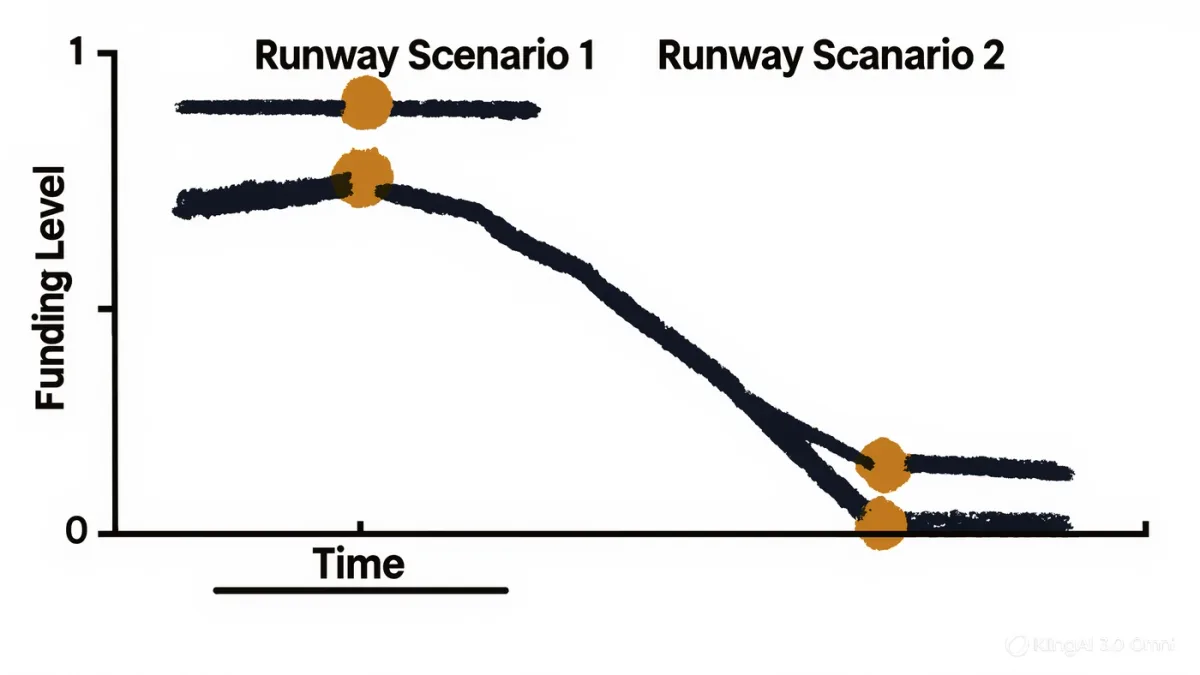
The calculation founders should run before signing any bridge. Inputs: months of runway the bridge adds (net of its own raise costs), the milestone it must produce, and what the next round requires that milestone to be. The arithmetic's core test: does the bridge's time plausibly produce the delta between your current metrics and the next round's bar? A company at $600,000 ARR growing 2x annually needs roughly a doubling of both to clear a Series A; a 9-month bridge that ends at $750,000 ARR has bought time and purchased nothing — the next raise happens in a weaker market position with a burnt bridge behind it. The documented failure signature: serial bridges — each one smaller, flatter, and from a narrower set of insiders, each deferring a valuation event the metrics cannot support, until the insiders stop.
When do bridges work?
The documented success cases share a structure: a named milestone with a deadline, an investor writing a real check at real terms, and a next-round thesis that the milestone completes. The canonical good bridges: the revenue quarter — six months to close the enterprise pipeline that converts a $1.2 million ARR story into a $2 million one; the product release — the version that unlocks a buyer category the current product cannot reach; the correction — burn cut deep enough that the bridge reaches default-alive, converting the raise question from existential to optional. In each, the bridge is a project with a deliverable, priced and scheduled like one.
What are the structural costs?
Even good bridges carry terms and signals. Terms: bridge SAFEs stack with the existing SAFE history and convert at the next priced round — a stack of escalating caps from serial bridges can consume a round's dilution before the new money prices it. Insider dynamics: bridge participation is the existing investors' honest vote — the documented pattern of some insiders declining the bridge is read by outside investors at the next round as diligence data, the signaling problem in its purest form. And the market's arithmetic: a company that has bridged once raises the next round's questions — 'why did the A not happen?' — which is survivable with a good answer and fatal without one.
What should founders negotiate in a bridge?
Six items from documented practice. The milestone, in writing, agreed as the bridge's purpose — not a slide's aspiration but a metric with a date. A cap (or discount) that respects reality — serial bridges with escalating caps against flat metrics simply pre-load the next round's collapse. Insider pro-rata discipline — who participates signals the syndicate's view to the market. A length calibrated to the milestone: bridges that are too short convert to serial bridges; too long and the burn they fund produces nothing fundable. Warrants or bonus coverage for bridging investors — market-standard compensation, negotiable in size. And the pre-agreed plan for both outcomes — what happens if the milestone lands (who leads, at what bar) and if it does not (the cut plan, decided before the bridge is signed, not after it fails).
What are the alternatives worth pricing?
Before any bridge, the honest comparison set: a deep cut — reducing burn to extend runway without new capital, which weakens the company but preserves the cap table and the optionality; venture debt — where a real milestone and an asset base make a loan cheaper than a stacked SAFE; a small flat priced round — crystallizing a valuation but clearing the deck for new investors; and the acquisition conversation — the option founders resist exploring until it is too late to negotiate. The bridge is one instrument among these, appropriate exactly when the milestone is real, close, and fundable — and a slow leak otherwise.
The bridge test is a sentence: name the milestone this money buys, the round it unlocks, and the date both arrive. If the sentence fills in cleanly, take the bridge. If it needs adjectives, the bridge is buying adjectives — and those convert at zero.