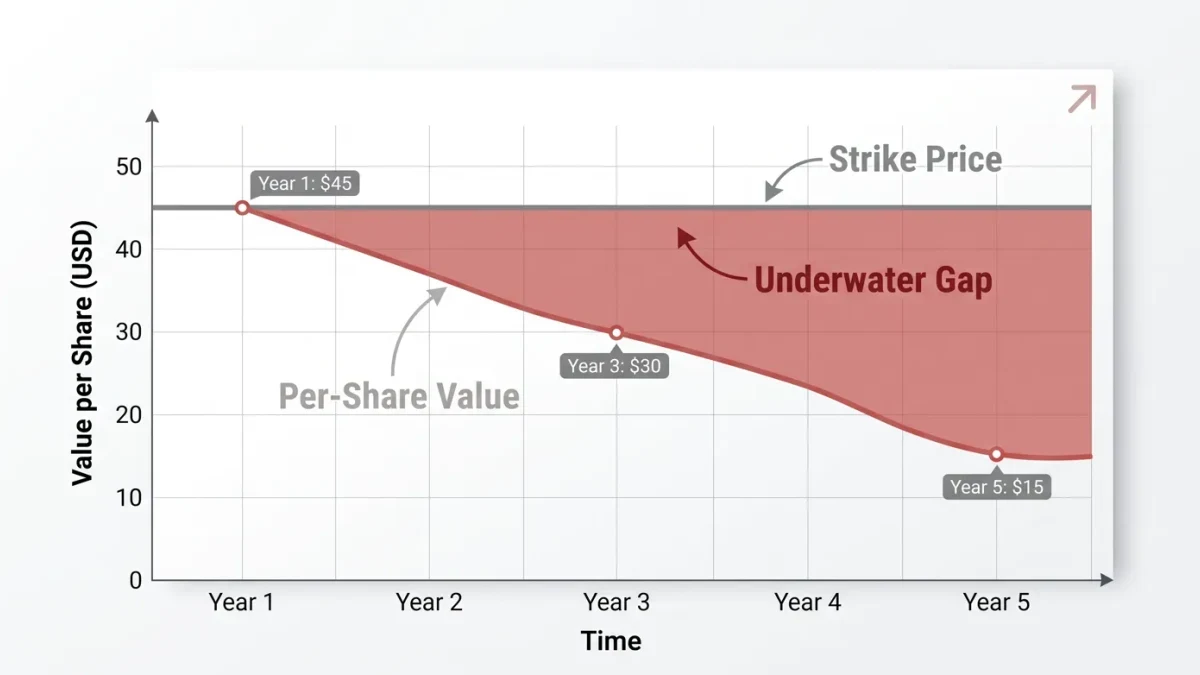
A down round is a financing round priced below a startup's most recent valuation, forcing the company's cap table to be recalculated under whatever anti-dilution terms sit in existing investors' contracts. Klarna is the clearest recent case: the Swedish payments company closed an $800 million round in July 2022 at a $6.7 billion valuation, down 85% from the $45.6 billion figure investors had assigned it a year earlier, according to Klarna's own announcement of the round.
The mechanics behind that kind of reset apply well beyond one fintech company. Anti-dilution clauses, pay-to-play provisions and the choice between a down round and a dressed-up "flat round" show up whenever a startup raises at a lower price than its last one.
What Actually Happens to Existing Investors in a Down Round?
Anti-dilution provisions reset the price at which earlier investors' preferred shares convert into common stock, and they come in two common forms, according to TechCrunch's breakdown of anti-dilution mechanics. A "full ratchet" clause drops the earlier conversion price all the way down to match the new, lower round price — the most aggressive version, and the one that dilutes founders and common shareholders the most. A "weighted average," or broad-based, clause instead blends the old and new prices with a formula tied to how much capital came in at each price, producing a smaller adjustment. Weighted-average terms are the more common structure in U.S. venture deals; full ratchet tends to show up when a company is negotiating from a weaker position.
A separate term, "pay-to-play," punishes investors who sit out the new round rather than protecting the ones who join it. Existing investors who don't put in new money can lose their anti-dilution protection and other preferred rights, effectively forcing a choice between reinvesting or being treated closer to a common shareholder.
Why Do Startups Take Down Rounds Instead of Alternatives?
Founders often resist down rounds because a lower price is public and permanent, showing up in every future pitch deck. Crypto lender BlockFi illustrated the alternative path in 2022, when it sought $100 million at a $1 billion valuation, down from the $3 billion figure it carried just 15 months earlier, according to TechCrunch's reporting at the time.
Some startups instead negotiate a flat round that preserves the old headline valuation but loads the new money with punitive terms: a 3x liquidation preference that pays new investors back three times their money before anyone else sees a dollar, participating preferred stock that stacks a fixed return on top of ordinary upside, or tighter anti-dilution rights. Venture investor Brad Feld has argued the flat-round path is worse for a company, telling TechCrunch that "just doing a clean resetting — at whatever the valuation so that everybody is aligned and dealing with reality — is much, much better for a company" than layering hidden terms onto an inflated number. The tradeoff in that reporting: a down round is harder on morale once employees see their options reprice, but it keeps the terms simple, and it doesn't hand later investors a stack of preferences from a round that never reflected the business.
How Did Klarna's Valuation Actually Move, Round by Round?
The repricing wasn't specific to Klarna. Buy now, pay later stocks fell broadly in 2022 as inflation and rising rates hit consumer-lending valuations across the sector — Affirm's shares were down 77% for the year and Block's down 61% by the time Klarna's round closed, while Apple had just entered the installment-loan market that June, according to CNBC's coverage of the round. Pulled together, Klarna's own numbers and contemporaneous reporting show a round-trip: a peak in 2021, an 85% cut in 2022, and a partial recovery at its 2025 listing that still landed well short of the earlier high.
| Date | Event | Valuation | Source |
|---|---|---|---|
| June 2021 | Growth funding round | $45.6 billion | Klarna / CNBC |
| July 11, 2022 | $800 million down round | $6.7 billion (-85%) | Klarna's own announcement |
| Sept. 9, 2025 | IPO pricing | ~$15.2 billion, fully diluted | Axios |
| Sept. 10, 2025 | First day of NYSE trading | Shares closed up 14.6%, at $45.82 | Fortune |
Who Backed the Down Round, and What Did They Get?
Klarna's $800 million round came from a mix of holdovers and new entrants: existing backers Sequoia Capital, Klarna's founders, Danish retailer Bestseller, Silver Lake and Commonwealth Bank of Australia put in more money, while Abu Dhabi's Mubadala Investment Company and Canada Pension Plan Investment Board joined as new investors, with Goldman Sachs advising, according to Klarna's announcement of the round.
Klarna CEO Sebastian Siemiatkowski framed the round as validation despite the price cut: "It's a testament to the strength of Klarna's business that, during the steepest drop in global stock markets in over fifty years, investors recognized our strong position," he said in the announcement. Sequoia partner Michael Moritz made a similar case, saying Klarna's "business, its position in various markets and its popularity with consumers and merchants are all stronger than at any time." Both are company- and investor-supplied characterizations, not independent findings — the announcement does not disclose revenue or profitability figures alongside them.
What Happened to Klarna's Valuation After the Down Round?
Klarna spent the three years after the down round pushing toward profitability while expanding in the U.S. market with the new capital, per the company's statements at the time of the raise. It went public on the New York Stock Exchange on Sept. 10, 2025, under the ticker KLAR, according to Klarna's own announcement of the listing. Shares priced at $40, implying a valuation of roughly $15.2 billion on a fully diluted basis and raising about $1.37 billion, according to Axios's reporting on the IPO pricing. Shares then closed their first trading day up 14.6%, at $45.82, according to Fortune's coverage of the debut.
That arc — $45.6 billion to $6.7 billion to roughly $15 billion at listing — is what a down round's aftermath can actually look like: a real cut, a real but partial recovery, and a return to public markets at a price still less than half the 2021 peak. Nothing in the public record shows Klarna's value returning to that earlier high.