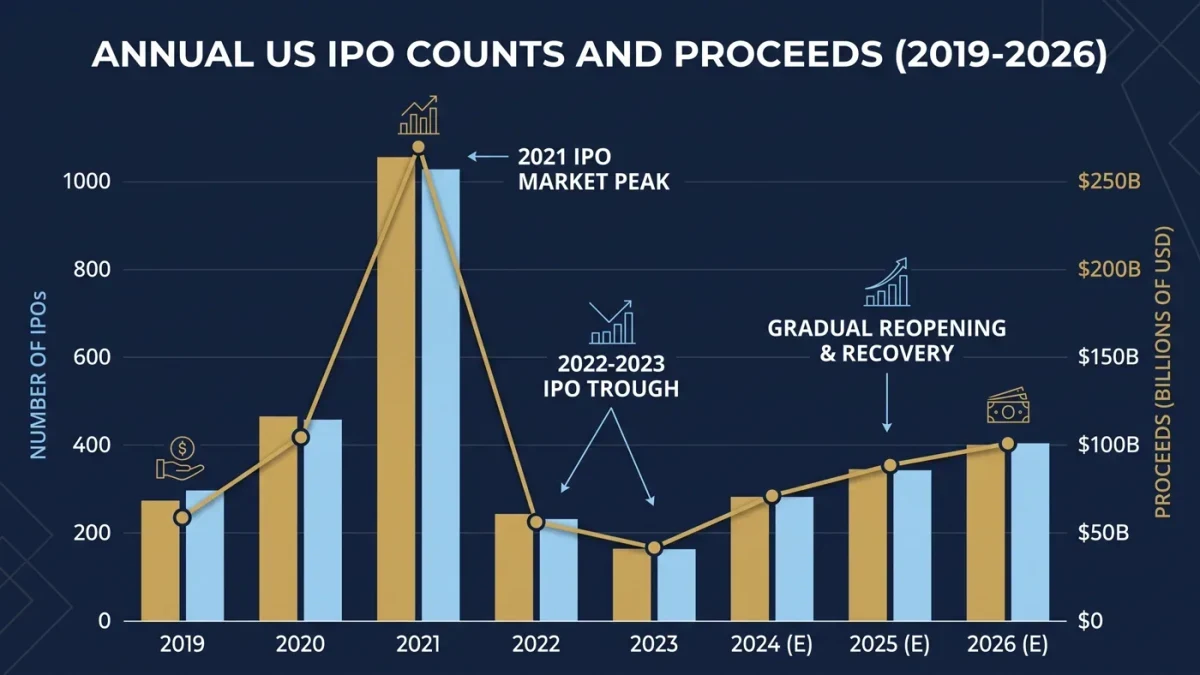
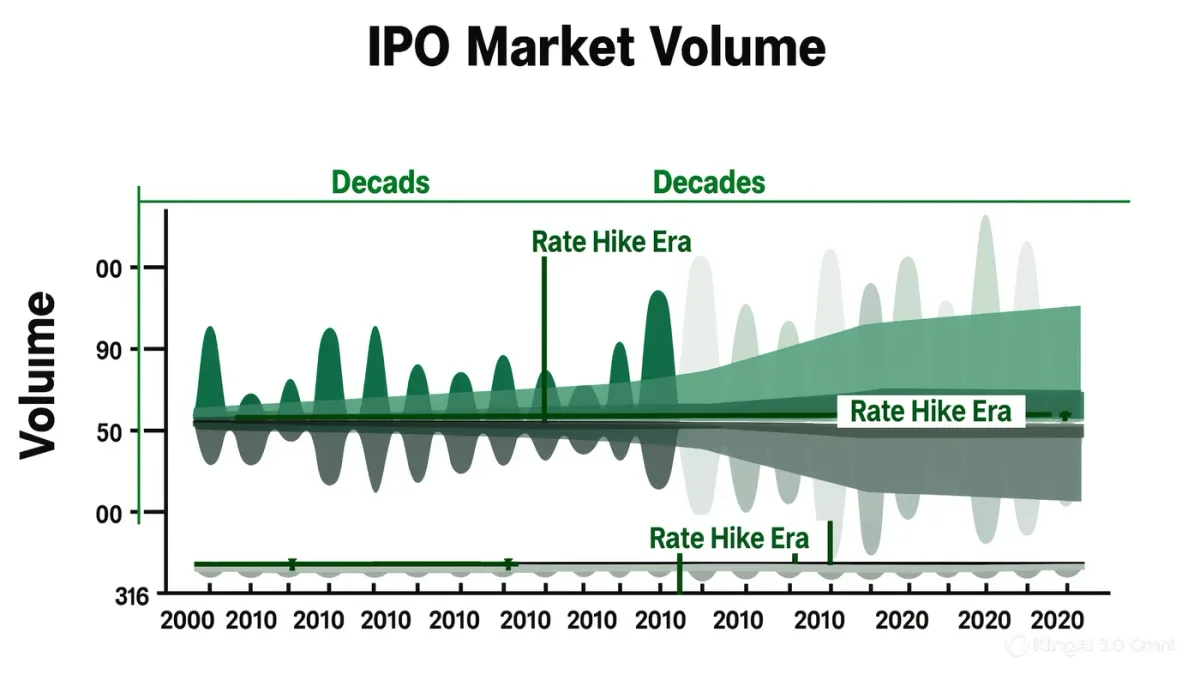
The IPO market runs in windows: multi-year stretches of near-total closure punctuated by quarters where everything lists at once. The 2025 reopening — Circle, Chime, Figma, Klarna, and the busiest calendar since 2021, per Reuters — followed a 2022-2024 freeze in which the market priced almost nothing. The pattern is old and documented, and its triggers are countable, which makes window-watching a discipline rather than a superstition.
What actually opens a window?
Four documented preconditions, roughly in order. Rates: the cost of capital sets the discount rate on every future cash flow — the 2020-2021 window opened at zero rates, and the 2025 opening tracked the Federal Reserve's easing cycle from late 2024. Comparables: newly priced deals trade against public peers, and a software IPO cannot price when public software trades at depressed multiples — the window for a category opens when its comparables recover, which is why windows differ by sector in the same macro. A successful bellwether: the first big deal of a window sets the risk appetite of every institutional buyer — one strong debut (a 2025 Circle or Figma) unlocks the calendar behind it, because allocators who missed the pop chase the next one. And supply-demand balance: windows close when the queue of issuers exhausts institutional cash — the 2021 experience, where a record year ended in broken deals and December cancellations as supply overwhelmed demand.
What slams them shut?
The shutdown triggers are faster than the opening ones. Macro shocks: a market correction above roughly 10 percent closes risk appetite in weeks — the March 2020 freeze and the 2022 tightening are the documented textbook cases, with the 2022 closure triggered by rate increases repricing growth stocks. The broken deal: one high-profile failed pricing — a deal cut, postponed, or trading below offer in week one — makes every subsequent issuer's buyer more cautious; underwriters pull deals preemptively to protect the calendar. And volatility itself: VIX above the mid-20s is the market's practical 'no-visibility' zone, because pricing a book requires a stable tape. The asymmetry matters for planning: a window opens over quarters and slams in days.
How should a company time against a window?
The documented discipline of the companies that actually got out: file when the window is merely visible, not open — the S-1 process takes a quarter, and the filing queue is the window's waiting room, with the SEC confidential-submission path letting companies stage filings without exposure. Price when the comparables and the bellwether align, and accept that perfection is unavailable — the 2025 class priced at good-not-great multiples relative to 2021, and every one of them is glad it did. And prepare the company, not just the filing: the audit, the public-company hires, the quiet-period discipline — the documented pattern is that readiness, not market genius, separates the listed from the stranded in every window; the 2021-2022 cohort that filed early in 2021 mostly got out, and the equally qualified cohort still preparing when the window shut waited three years.
What does the current cycle's record show?
The 2025 reopening's documented shape: quality-first — the market priced profitable or near-profitable companies (Circle's reserve income, Chime's first profit, Figma's retention) and punished concepts; dispersion after the pop — the window rewarded retention metrics with durable trading and reverted fintech multiples toward bank comparables within quarters; and a heavy pipeline staged behind it, with the mega-private companies — Stripe, Databricks, Canva, the AI labs themselves in some form — positioned as the window's second act, each one's filing decision partly a function of the last one's aftermarket. The window's second-year test, historically, is whether the second act prices as well as the first: the 1999 and 2021 precedents both failed it; 2026's verdict was still being written.
Windows are market weather: not predictable in detail, but seasonal in pattern, observable in real time, and survivable only with preparation done in advance. The companies that list are almost never the ones that timed the window perfectly — they are the ones ready when it opened.