
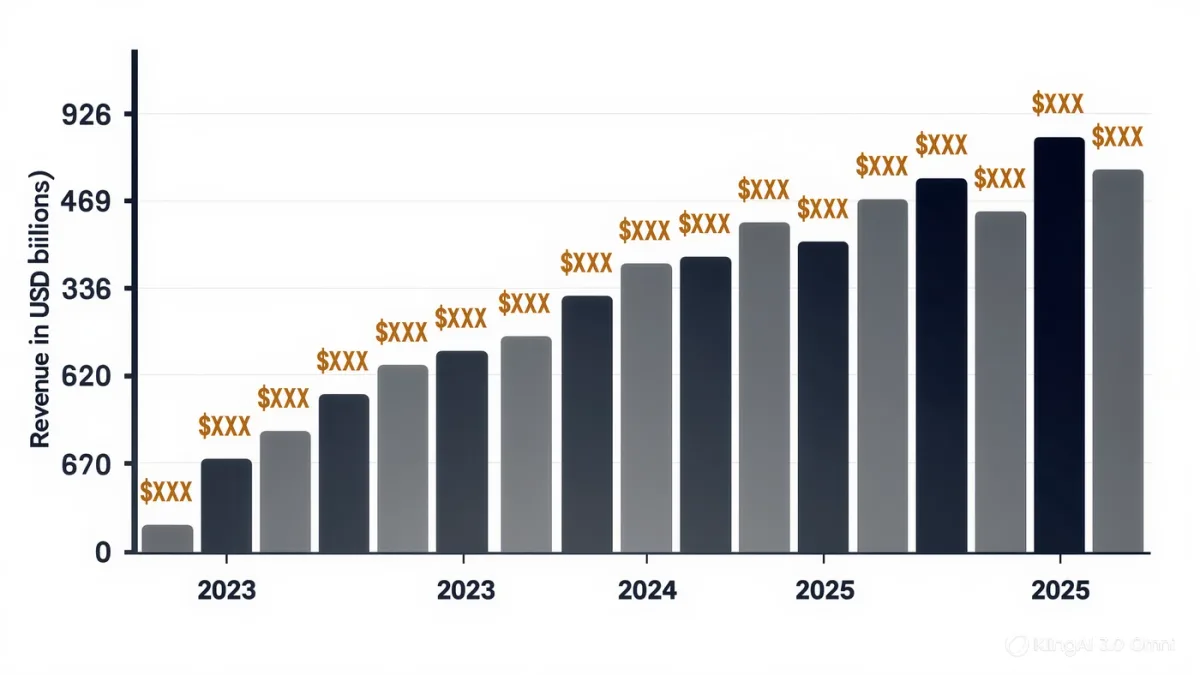
OpenAI's business model, judged strictly on the documented record through late 2025, is a race between two exponential curves: revenue that reportedly passed $10 billion in annualized terms during 2025, and compute obligations that grow at least as fast because the company pays for the capacity that produces the revenue. Every figure below is labeled by what it is: company-claimed, investor-reported, or filed.
What does the revenue record actually show?
The revenue numbers are company-claimed and press-reported, not audited public filings. Reported annualized revenue passed $10 billion during 2025, up from roughly $3.7 billion in 2024 — growth of nearly 3x year over year, driven overwhelmingly by ChatGPT subscriptions rather than API access. That mix matters: consumer subscriptions are high-volume and price-sensitive, while the enterprise and API segments, which investors value for durability, are the smaller share of the total. The company declined to disclose audited financials, and it has that right as a private company; the consequence is that every public growth figure carries the same asterisk.
Why is compute the structural cost problem?
Most software companies ship marginal copies at near-zero cost. OpenAI's marginal copy requires inference compute on dedicated datacenters, and its frontier training runs require multi-billion-dollar clusters booked years ahead. The company's response has been to turn capital expenditure into commitments: the Stargate datacenter venture announced in January 2025, with reported commitments in the hundreds of billions over multiple years, and the $400 billion of compute obligations over five to seven years that Reuters reported citing an investor presentation in September 2025. Those numbers are commitments, not spending — but they are commitments priced against revenue that must arrive on schedule to cover them.
What did the SoftBank round actually buy?
The March 2025 $40 billion round, led by SoftBank at a $300 billion post-money valuation, was reported by Reuters to be structured in tranches — an initial roughly $10 billion, with the remainder contingent in part on OpenAI completing its restructuring into a for-profit public benefit corporation. Tranching is a risk-splitting device: the investor pays for milestones, not promises. It also tells you what the largest single check in private-market history was hedging — governance form and capital-plan execution, not the product.
Is the valuation defensible on the record?
At $300 billion post-money, with reported annualized revenue near $10 billion to $12 billion in late 2025, the company trades privately at roughly 25-30x current revenue — a multiple that assumes both hypergrowth and eventually wide margins. The documented supports: consumer subscription scale measured in the hundreds of millions of weekly users (company-claimed), enterprise adoption, and a market position where the top of the model market has consolidated around a handful of labs. The documented gaps: no audited financials, no disclosed retention or margin figures, compute commitments that scale with usage, and competition from open-weights models that compress pricing at the capability frontier's mid-tier. An honest analysis stops here: the record supports extraordinary growth; it does not yet support a margin structure, because the company has not published one.
What are the biggest open questions?
Three questions dominate, and none has a documented answer. First, consumer price tolerance: ChatGPT's paid tiers carry the revenue, and price increases announced for 2026 will test how elastic that base is. Second, enterprise durability: API and enterprise contracts are the margin story, and competitors — Anthropic in particular, per enterprise deal reporting — are winning share inside large corporations. Third, the dependency structure: OpenAI's compute position depends heavily on Microsoft for capacity under an agreement renegotiated in 2025 to give OpenAI the right to source compute from third parties, including a large Oracle cloud commitment reported at roughly $300 billion over five years. The renegotiation resolved the exclusivity question; it did not publish the unit economics.
How does this compare with prior platform shifts?
The optimistic comparison is early Amazon: enormous reported losses that were actually infrastructure investment, later monetized. The pessimistic comparison is a utility with a fashion risk: if frontier-model differentiation compresses — as open-weights releases during 2025 suggested at the mid-tier — pricing power erodes while the fixed compute base stays on the balance sheet. The record contains evidence for both readings and proof of neither, which is the honest conclusion, and the one this desk will hold until the company discloses audited figures or files to go public.
What would change the analysis?
Watch for three disclosures rather than sentiment. Audited financials, which the PBC structure makes more plausible as it takes institutional capital. Retention and net-revenue-retention figures for enterprise, which would establish whether the API business behaves like durable software. And realized compute cost per token over time, which the company claims is falling rapidly — a claim consistent with published inference-efficiency work but never audited externally. Each is checkable; none is checkable today.
The verdict the evidence supports: the fastest-scaling revenue machine in software history, wrapped around a cost structure the public record cannot yet price. The bull and bear cases are both intact, which is itself the finding.