
The difference between a pre-seed and a seed round is not the size of the check — it is what the money is hired to prove. A pre-seed round, typically $250,000 to $2 million, exists to answer one question: is there a real problem here worth solving? A seed round, typically $2 million to $6 million in the United States as of 2025, exists to answer a harder one: can this team get strangers to pay for the solution repeatedly? Founders who raise a seed priced like a pre-seed outcome, or spend a pre-seed chasing seed-stage metrics, set both rounds up to disappoint. Honey Badgers publishes information, not investment advice, and every figure below reflects publicly reported market norms, not a recommendation.
What does a pre-seed round actually buy?
Pre-seed capital buys evidence of the cheapest possible kind. The money funds a founding team for roughly 12 to 18 months while they run customer discovery interviews, build a rough first version of the product, and ideally land a handful of design partners — early users who agree to use, and preferably pay for, something unfinished. Investors at this stage, usually angel investors and small pre-seed funds writing $25,000 to $500,000 checks, are underwriting the team and the problem, not traction. A pre-seed round done well ends with a demonstrable signal: a repeatable sales conversation, a waiting list, or a first $10,000 of contracted revenue that shows someone outside the founding circle cares.
What does a seed round expect in return?
Seed investors expect a product in the market and the first curve of commercial evidence. The standard bar, as of the mid-2020s market, is often summarized as $1 million of annual recurring revenue or a credible trajectory toward it, though the bar moves with the sector — a hard-tech or biotech seed sells technical milestones instead of ARR. A seed round of $3 million to $5 million typically funds 18 to 24 months of runway, enough to hire a small go-to-market team, reach $2 million to $3 million ARR, and raise a Series A on momentum. The math is unforgiving: dilute 20 percent of the company now, and the round must produce enough valuation growth that the next raise clears the entry price comfortably.
How much do founders give up at each stage?
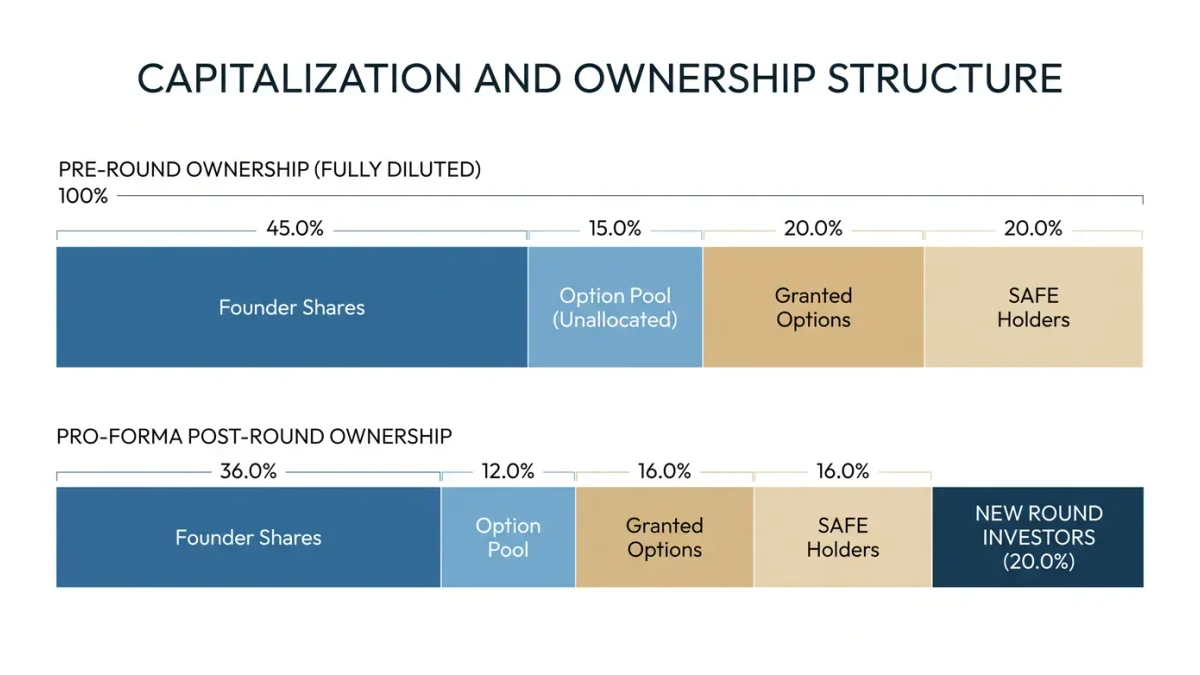
Dilution is the price of the money, and each stage has a range the market treats as normal. Pre-seed rounds usually sell 10 to 15 percent of the company; seed rounds sell 15 to 25 percent, with 20 percent as the number most terms cluster around. A founder who sells 30 percent at pre-seed and another 25 percent at seed owns less than half of the company before institutional growth capital arrives — a cap-table problem that surfaces years later, when employee option pools and Series B pricing squeeze the founder stake below the level needed to keep control of their own incentives. The percentages matter more than the valuations, because percentages compound.
Why do the instruments differ between the stages?
Pre-seed money usually arrives on SAFE notes — Simple Agreements for Future Equity — that defer the valuation question to the next priced round. Seed money increasingly arrives on priced equity, with a lead investor setting a valuation, a board seat, and a set of protective provisions. The instrument choice is a signal: a SAFE says nobody priced the company yet; a priced round says someone did. Founders should not read a large SAFE round as equivalent to a priced seed at the same headline number, because SAFEs stack and convert at whatever price the future round sets — a mechanic that punished plenty of companies when 2021-era SAFE stacks converted into 2023-era down rounds.
What metrics separate the stages in practice?
The practical checklist is short. Pre-seed readiness: a team with relevant edge, 30 or more documented customer conversations, and a prototype. Seed readiness: live product, five to ten paying customers or committed pilots, some evidence of retention beyond the first month, and a founder who can name exactly who buys and why. Series A readiness, for context: roughly $1 million to $2 million ARR, a repeatable sales motion, and retention data that survives three or more customer cohorts. Founders who present seed-stage asks with pre-seed-stage evidence get one of two bad outcomes — a pass, or a yes at terms that assume the risk of both stages at once.
When should a founder skip pre-seed entirely?
Not every company needs a pre-seed round. Repeat founders with an exit behind them routinely raise priced seeds on a deck, because investors are buying a track record instead of evidence. Bootstrapped companies that reach $500,000 of revenue on savings and consulting revenue can often skip straight to a large seed or a small Series A. The reverse also holds: a first-time team attacking a deep-technical market may need a pre-seed plus a seed bridge before any ARR exists at all. The stage labels describe evidence, not chronology, and the founders who negotiate best are the ones who know exactly which question their current round is being asked to answer.
What do the stages mean for how fast the money must move?
Every round buys a fixed amount of time, and time is the real product being sold to investors. At a $500,000 pre-seed with a $40,000 monthly burn, the team has about 12 months. At a $4 million seed with an $180,000 monthly burn — a lean seed-stage budget for a team of eight to ten — the company has about 22 months. The raise itself eats three to six months of founder attention, which means the actual productive window between rounds is shorter than the runway math suggests, and founders who plan to the last month of cash are planning to fail. The market's quiet rule of thumb, reported consistently across venture surveys: start raising when six months of runway remain, not two.
The stages are a language for evidence. Pre-seed proves the problem, seed proves the sale, Series A proves the machine. A founder who knows which proof their round owes the next investor negotiates from a position of clarity — and one who does not is negotiating against themselves.