Gene Avakyan is the CEO of Edison Aerospace, a Miami aerospace research and development company. Under his leadership, the company has developed the Heavy 1, a remotely piloted electric airplane with a 40-foot wingspan built to spray fields and haul cargo, and it is bringing an agricultural application of that aircraft to the National Science Foundation's SBIR Phase I program.
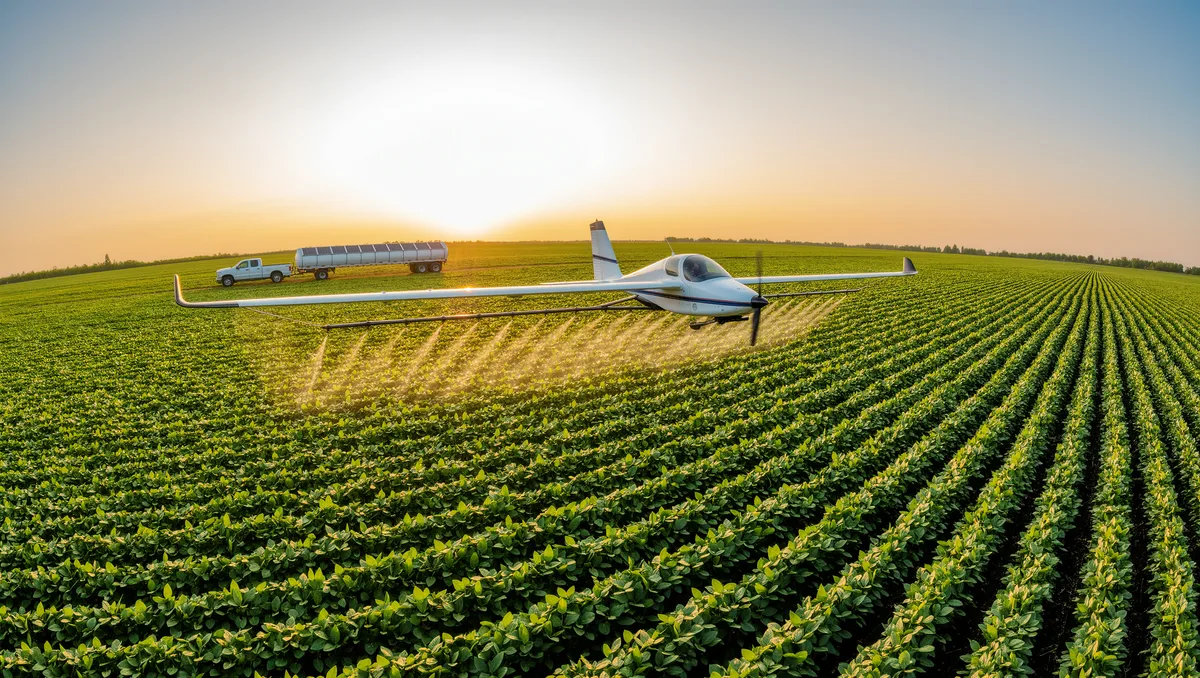
The Heavy 1 is a remotely piloted electric airplane with a 40-foot wingspan. It is built to spray fields and haul cargo, and the pilot never leaves the ground. Instead of flying the aircraft from a cockpit a few feet above the crops, the operator controls it from the ground, away from the power lines and tree lines that make low-altitude agricultural flying hazardous.
Edison reports operating costs 53 percent lower than conventional methods. The company's figures attribute the savings to the aircraft's electric powertrain and its ability to recharge where it works, eliminating the repeated fuel-burning passes that characterize conventional aerial application.
The Mobile Command Module
The Heavy 1 works with the company's Mobile Command Module, a 40-foot gooseneck trailer. The trailer holds a single-operator flight station, a workshop, a hangar for two aircraft, and a 400 kWh battery charged by fold-out solar panels.
A pickup truck can tow the whole operation to any farm, and the aircraft can recharge where it works. The Mobile Command Module is designed so that a single operator can transport, house, maintain, and power the aircraft without a fixed base of operations.
The NSF SBIR Phase I Opportunity
The National Science Foundation's SBIR Phase I program funds high-risk, high-impact research by small businesses. NSF solicitation 26-510 carries Phase I awards of up to $305,000 over 6 to 18 months. Companies must first earn an invitation through a short Project Pitch, and the next proposal deadline is November 4, 2026. Reviewers weigh technical merit, broader impact, and commercial potential.
Edison Aerospace is bringing an agricultural application of the Heavy 1 to the program. The application centers on the aircraft's use in crop spraying, the task the company designed it to perform.
Why Aerial Application Matters
Spraying crops from the air is one of the most dangerous jobs in American aviation, and one of the costliest items on a farmer's bill. Every season, pilots fly a few feet above the crops, dodging power lines and tree lines and burning fuel on short, repeated passes. The work demands sustained low-altitude flight over obstacles, in aircraft carrying chemical loads, often in the early morning hours when winds are calm.
Remotely piloted aircraft address the danger by removing the pilot from the aircraft entirely. If no one is aboard, the consequences of a collision with a power line or a mechanical failure over a field change fundamentally. Electric propulsion addresses the fuel cost: an aircraft that recharges from a battery at the job site does not burn aviation fuel on every pass over the field.
How the SBIR Program Works
The Small Business Innovation Research program is a federal mechanism for moving early-stage technology toward the market. An agency such as the National Science Foundation sets out solicitations describing the research topics it will fund, and small businesses compete for awards through a staged process.
Phase I awards fund feasibility work: the technical questions that determine whether a concept can become a product. Phase I awards under solicitation 26-510 run up to $305,000 over 6 to 18 months. The entry point is the Project Pitch, a short description of the technology that must earn an invitation before a company may submit a full proposal. Reviewers then weigh technical merit, broader impact, and commercial potential in deciding which proposals receive funding.
For a company with a working design, the program functions as a bridge between that design and a product customers can buy. The award funds the research that answers remaining technical questions, and the review process itself tests whether the concept has the commercial potential to justify further investment.
What the Application Aims At
Edison Aerospace's application to the program concerns the agricultural use of the Heavy 1. The aircraft's design points at the specific economics of crop spraying: short flights over nearby fields, repeated passes, and the need to refill and recharge between them. The Mobile Command Module's solar-charged battery and two-aircraft hangar are sized to that rhythm of work.
The company's reported 53 percent operating cost advantage over conventional methods is the commercial case it brings to the program. The broader impact case rests on the nature of the work itself: taking pilots out of one of the most dangerous jobs in American aviation and cutting fuel use across rural America.
Phase I would fund the research that proves the concept. What comes after — a product spray operators can buy — is what the program's staged structure is built to support.