
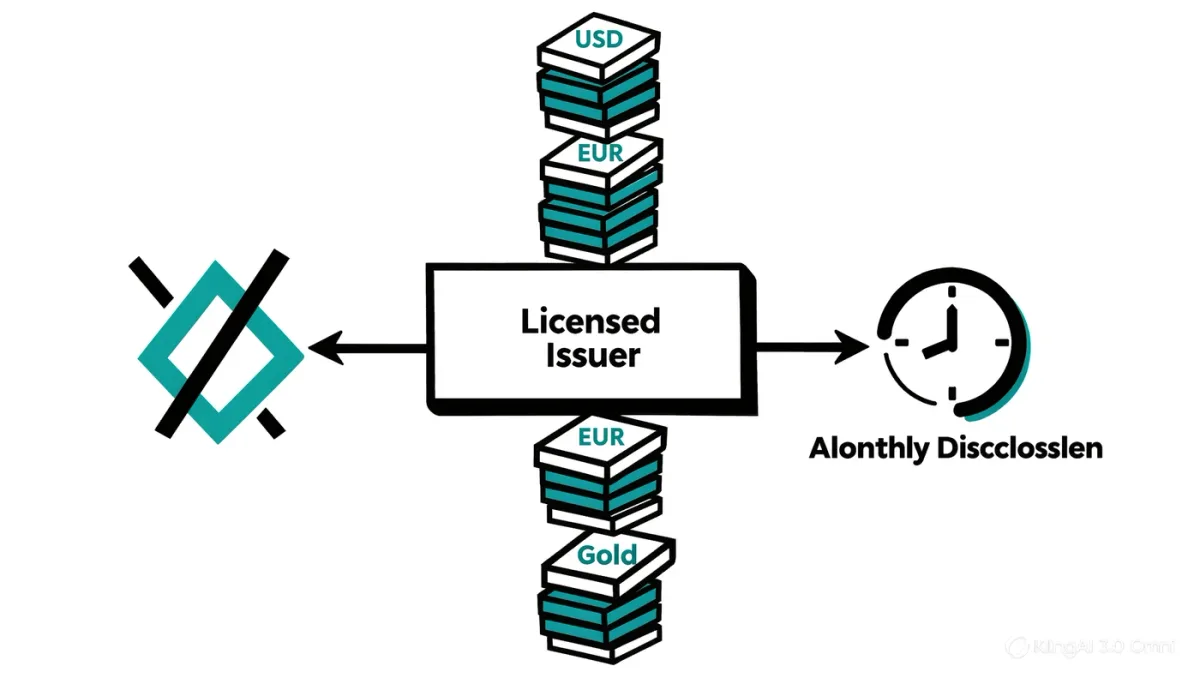
The GENIUS Act — the Guiding and Establishing National Innovation for U.S. Stablecoins Act — was signed into law on July 18, 2025, establishing the first federal framework for payment stablecoins: issuers must be licensed, reserves must be held in cash and high-quality liquid assets with monthly disclosures, and algorithmic stablecoins backed by their own issuer's tokens are prohibited. The market responded immediately: Circle's shares, listed weeks earlier, rallied on the regulatory clarity, per Reuters. For startups, the law converted a gray zone into a licensed market with published rules — which redistributes where the opportunity is. Honey Badgers publishes information, not investment or legal advice.
What does the law actually require?
The documented core provisions. Licensing: issuers must obtain a federal or qualifying state charter, with regulators empowered to examine and enforce. Reserves: one-to-one backing by cash, short-term Treasuries, and approved equivalents, segregated from the issuer's operating funds, with monthly public disclosure and annual certification. Redemption: holders' right to redeem at par, on demand, with the issuer obligated to honor it. Prohibitions: no algorithmic stablecoins whose reserve is the issuer's own token — the Terra-style structure — and restrictions on paying interest to stablecoin holders, a provision whose boundary definitions drew the heaviest lobbying. The effective dates phase through 2026 for existing issuers, giving the market a compliance calendar.
Who won and who lost under the framework?
The documented winners: incumbent compliant issuers — Circle above all, whose listing made it the law's public-market proxy and whose disclosure practices already approximated the requirements; banks, for whom the law opened a permissible path into issuance without the reputational ambiguity that had kept most on the sidelines; and the payments ecosystem, which gained the legal certainty that consumer-facing stablecoin features require. The documented losers: offshore-first issuers serving U.S. users, now choosing between licensing and exit — Tether, the largest, publicly weighing a U.S. move with audits it had long resisted; interest-paying stablecoin models, restricted by the no-yield provision; and algorithmic-structure projects, eliminated outright. The law's quietest effect: it nationalized a market that states had been improvising over, ending the fifty-state patchwork.
Where did the startup opportunity move?
The documented post-law pattern in venture formation and funding. Infrastructure over issuance: the licensed-issuer market's economics favor scale and compliance budgets — banks and Circle — while startups build the rails: issuance-as-a-service platforms for banks entering the market (the documented boomlet of stablecoin-infrastructure providers post-law), custody, compliance and reserve-attestation tooling, and cross-border payment orchestration. Stripe's Bridge acquisition — reported at $1.1 billion in late 2024, ahead of the law — became the category's reference outcome, and the payments majors moved in force through 2025: Visa and Mastercard expanding stablecoin settlement, PayPal extending PYUSD's footprint. The application layer: consumer wallets, remittance products, and merchant acceptance — the law's par-redemption and disclosure requirements giving product teams the legal floor to build on. The honest constraint the record adds: the no-interest provision caps the consumer-deposit-competing use case, steering the market toward payments utility rather than yield products.
What are the open questions after the law?
The documented unsettled edges: the market-structure bill alongside it — CLARITY, dividing digital-asset jurisdiction between the SEC and CFTC — remained in negotiation into 2026, leaving token securities questions adjacent to stablecoins unresolved; the state-federal licensing boundary's details, which New York's regime complicated by conditioning its charter on federal non-preemption; enforcement posture toward offshore issuers serving U.S. users by default; and the banking agencies' interpretation of what bank-issued stablecoins mean for deposit funding — the variable that decides whether the bank-issuance wave is large or decorative. Each is a rule yet to be written by practice.
The GENIUS Act is the rare regulation that expanded its market: clarity brought in banks, payments networks, and the startups building their tooling. The gray zone closed; the infrastructure race opened — and this time with published rules.