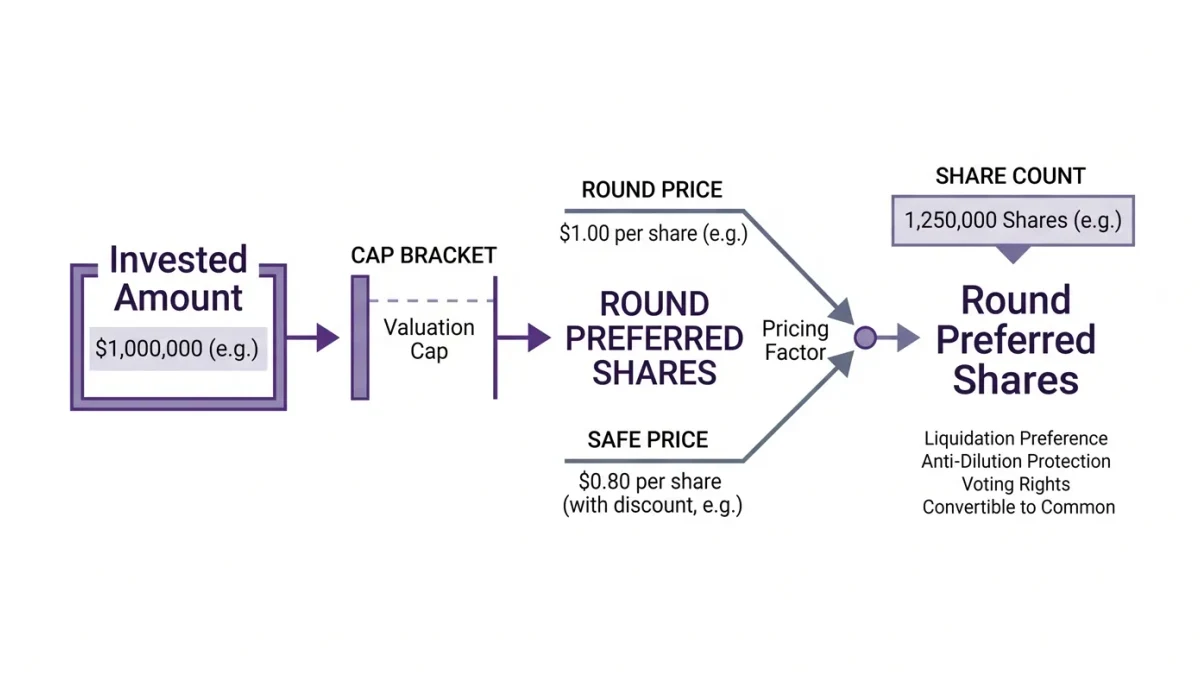

A SAFE is a short contract that lets an investor fund a startup now in exchange for the right to shares later, according to Y Combinator, the accelerator that created the instrument in 2013. It is not a loan and it is not stock — it converts into equity when the company closes a priced funding round, most commonly a Series A. Y Combinator says the SAFE has been used to raise more than $15 billion for its portfolio companies.
Founders reach for a SAFE because it skips a valuation fight at the seed stage. Instead of pricing the company today, both sides agree on the terms that will apply once someone else — a lead investor in a later round — sets the price.
How does a SAFE actually convert into equity?
The mechanism is deferred, not immediate, according to Y Combinator's own documentation. An investor wires money at signing but receives no stock that day. The SAFE sits on the company's books until a triggering event, typically a priced equity round, at which point it converts into shares using whichever term — a valuation cap, a discount, or both — produces the better outcome for the investor.
Because nothing is priced upfront, a company can close a SAFE round in days rather than the weeks a priced round with a term sheet and new share class typically takes.
What is a valuation cap, and what does it do?
A valuation cap sets the maximum company valuation at which the SAFE converts, per Y Combinator's documentation. If the priced round that triggers conversion values the company above the cap, the SAFE holder still converts as if the company were only worth the capped amount — receiving more shares for the same dollar investment than a new investor coming in at the higher, uncapped price.
The cap is what lets an early check-writer get rewarded for taking risk before the company has a market-set price. The lower the cap relative to the eventual round valuation, the more shares the SAFE investor collects.
What does the discount rate do, and how is it different from the cap?
A discount rate gives the SAFE holder a percentage reduction off the price per share that new investors pay in the priced round, according to Y Combinator. Where the cap sets a ceiling on valuation, the discount is a straight markdown on whatever price the round eventually sets. Many SAFEs carry both a cap and a discount, and the contract converts using whichever term is more favorable to the investor at the time of conversion.
A SAFE can also carry a most-favored-nation, or MFN, clause. Y Combinator's documentation describes MFN terms as ensuring that if a founder later issues a SAFE with better terms to a different investor, earlier MFN-holding investors automatically get upgraded to match.
Pre-money or post-money — why does the SAFE version matter?
Y Combinator now standardizes on a post-money SAFE, but the distinction between the two versions changes what founders actually give up. A pre-money SAFE is more favorable to founders because it functions like debt-free, pre-valuation funding, according to a 2019 TechCrunch analysis of the two structures. A post-money SAFE, by contrast, sweetens the terms for investors by locking in their exact ownership percentage at conversion, regardless of how many other SAFEs get issued afterward.
The practical difference shows up in the cap table. With a pre-money SAFE, ownership percentages are, in TechCrunch's framing, an "informed estimation" until the round actually closes, because the calculation has to account for a future option-pool expansion. A post-money SAFE removes that guesswork: the investor's stake is simply the valuation cap divided by the company's total post-money capitalization, since all outstanding SAFEs are folded into that denominator up front.
Dilution lands on different people depending on which version a founder signs. Under a pre-money SAFE, existing shareholders — founders and early employees — absorb dilution from every round that follows, while pre-money SAFE holders are also diluted by later rounds. Under a post-money SAFE, early SAFE investors are shielded from dilution entirely until the priced round happens, and founders absorb dilution from both new investors and the SAFE holders who came before them, per TechCrunch's analysis. The same reporting suggests post-money SAFEs suit raises above roughly $2 million, while smaller raises tend to favor the founder-friendlier pre-money structure.
| Feature | Pre-Money SAFE | Post-Money SAFE |
|---|---|---|
| Who it favors | Founders | Investors |
| Ownership math | Estimated until round closes | Cap ÷ total post-money capitalization |
| Dilution before conversion | Shared across existing shareholders and prior SAFE holders | Investor is shielded; founders absorb it |
| Typical fit | Smaller raises | Raises above roughly $2 million |
Where do founders get the dilution math wrong?
The most common failure is treating the valuation cap as a floor for the eventual priced round, rather than doing the compounding math, according to a 2017 TechCrunch analysis of SAFE-related dilution problems. Founders who stack multiple SAFEs at different caps without modeling the combined effect can be blindsided at the priced round: the same reporting describes a founder who expected to retain 78% ownership ending up with 35% once every note converted.
The distortion compounds with each additional note. TechCrunch's analysis describes a "multiplier effect" on post-money valuation as more SAFEs stack up — the wider the gap between the note caps and the eventual priced-round valuation, the bigger the gap between what a founder expected to own and what they actually own after conversion.
That stacking problem has a second-order consequence: new institutional investors sometimes walk away from deals specifically because the accumulated SAFE notes would eat too much equity for the new investor to hit its target ownership without a recapitalization, per the same TechCrunch reporting. In the worst cases, the resulting cap-table pressure can force the company into a down round — a priced round at a lower valuation than the SAFE terms implied — rather than the up round everyone assumed was coming.
What should founders actually check before signing a SAFE?
Run the conversion math with every existing SAFE included, not just the new one being signed, and model it against a range of eventual round valuations rather than a single optimistic number. The gap between a capped SAFE's implied ownership and what actually gets delivered at conversion only shows up when every outstanding note is stacked together — waiting until the priced round to do that math, as TechCrunch's reporting describes, is what turns a routine seed close into a surprise.