Hard-tech founders rarely fail for lack of ideas. They fail because a lab prototype needs a cleanroom, a fab partner, and money that survives a long development cycle — and none of those sit inside a university department. Georgia Tech put that problem on a table on Oct. 22, when the Institute for Matter and Systems (IMS) hosted its second annual Founders Night in Atlanta. According to Georgia Tech, the event connected entrepreneurs with facilities, funding, product development expertise, and manufacturing resources.
The useful part for founders outside that room is the map the evening drew. It shows, in one place, the categories of support a hardware startup typically needs: shared facilities, regional funders, product development help, and contract manufacturers. That structure holds whether the startup is in Atlanta or anywhere else. This guide breaks down each category, using what the event surfaced as the reference frame. Readers following this should also see How a SAFE Actually Converts at Your Priced Round, With the Math That Surprises Founders.
What happened at Founders Night?
Hard-tech founders, researchers, and innovation partners gathered at IMS for the second annual event. Billyde Brown, external user outreach manager and senior research engineer at IMS, organized it around three goals: celebrating founders, connecting them with innovation partners, and strengthening support for hard-tech startups in Atlanta.
"Founders Night is about bringing all of these players together so we can network, collaborate, and make connections," Brown said, according to Georgia Tech. The evening closed with tours of IMS's Materials Characterization Facility and Micro/Nano Fabrication Cleanroom, followed by a networking reception.
Eric Vogel, IMS's executive director, framed why the gathering matters. "Progress rarely happens in isolation," he said. "You need to interact with people with different experiences and capabilities, share ideas, make an introduction and challenge an assumption."
Why do hard-tech founders need shared facilities first?
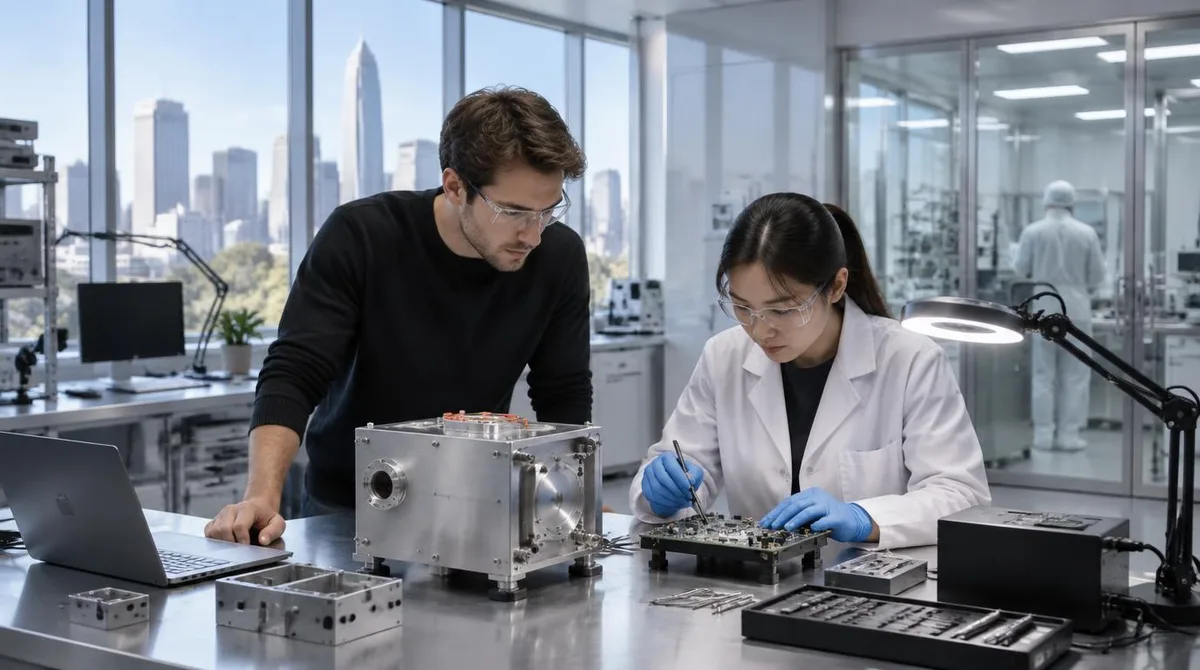
A software founder needs a laptop. A hard-tech founder needs a cleanroom, characterization equipment, and someone who knows how to run it. Those cost millions to build and cannot be rented by the hour in most cities. University shared facilities exist to close that gap, and the Georgia Tech event ended with tours of exactly two: the Materials Characterization Facility and the Micro/Nano Fabrication Cleanroom.
For a founder, the practical lesson is to identify the specific instruments a prototype requires before choosing where to build. A materials startup that needs electron microscopy has different facility needs than one that needs nanoscale patterning. Asking a potential host facility what it runs — and what its queue looks like — is a reasonable early diligence step, and events like Founders Night exist to make that introduction happen in person rather than through a cold email.
Which funders show up for hard tech — and why does it matter which ones?
The event highlighted resources from the Metro Atlanta Chamber, the Georgia Research Alliance, and Kicker Labs. Per Georgia Tech, these organizations offer support ranging from funding to product development assistance. Hard-tech founders should note the mix: a Chamber, a research alliance, and a lab-adjacent program are not venture funds. Early hardware money often comes from regional and public-adjacent sources before institutional rounds arrive.
That sequencing matters. Founders weighing regional grants against institutional money can read how the tradeoffs differ in Angels vs VCs: A Founder's Comparison, and the mechanics of early-stage paperwork in How a SAFE Actually Converts at Your Priced Round, With the Math That Surprises Founders. The broader funding landscape is covered on our funding hub.
What does manufacturing access actually look like?
Georgia Tech named two manufacturing pathways at the event: LioniX International and Silex Microsystems. Both offer commercial manufacturing, and the university notes the organizations present offered support extending to site selection and commercial manufacturing. For a hard-tech founder, this is the category most often missing from a university ecosystem: a lab can prove a device works, but producing it at volume requires a foundry or fab partner with process expertise the startup does not have.
The durable takeaway is to treat manufacturing as a partnership decision, not a procurement one. Process compatibility, minimum order sizes, and iteration speed all shape what a hardware startup can design at all. Founders who identify a manufacturing pathway early — as the event encouraged — avoid redesigning a product around a fab's constraints after the fact.
What do founder examples from the event show?
Two Georgia Tech founders illustrated the lab-to-market path. Mark Prausnitz, Regents' Professor, Regents' Entrepreneur, and J. Erskine Love Jr. Chair in Chemical and Biomolecular Engineering, described how his laboratory's microneedle research has supported companies in drug delivery, eye care, and dermatology. Harry Watkins, co-founder and president of Stellar Scale Nano Fabrication, described how the Georgia Tech spinout is commercializing a faster nanoscale 3D-printing platform.
The pattern is worth naming plainly. Both examples are faculty-adjacent: one professor whose research seeded multiple companies, and one spinout built on institute research. That is the documented model here — research originating inside the university, then commercialized with the ecosystem's support. Founders without a university lab affiliation face a different entry path, and the honest reading of this event is that it primarily serves researchers and their partners.
How can a founder outside Atlanta use this playbook?
The categories transfer; the names may not. A founder anywhere can run the same audit Georgia Tech staged in one evening:
- Shared facilities: which local institutions run the equipment the product needs?
- Regional funders: which chambers, research alliances, or lab programs fund early hardware?
- Product development help: who offers engineering support before a full team exists?
- Manufacturing: which foundries or fabs work with early-stage companies?
"We want to support and enable founders by connecting them with local innovation ecosystem partners who can provide critical resources, facilities and other assistance," Brown said, per Georgia Tech. The mechanism is introductions. The founders section of this site tracks the people and decisions behind startups, and our startups hub covers the company side of the same ecosystem.
What the record establishes is a functioning model: a university convening researchers, funders, and manufacturers in one room, twice now. What it does not establish is outcomes — the event coverage names no funding amounts, no company milestones, and no timelines. Founders reading it should treat the resource map as the durable content and the cheerfulness as decoration.