
A SAFE — Simple Agreement for Future Equity — is a one-page promise: money now, shares later, at a price determined by whichever priced round happens next. A priced round sells shares now, at a negotiated valuation, with full documentation, a board seat usually attached, and legal bills that run to tens of thousands of dollars. The SAFE's speed made it the default instrument of the 2010s and 2020s seed market; its deferral mechanics also produced some of the era's ugliest cap tables.
How does a SAFE actually convert?
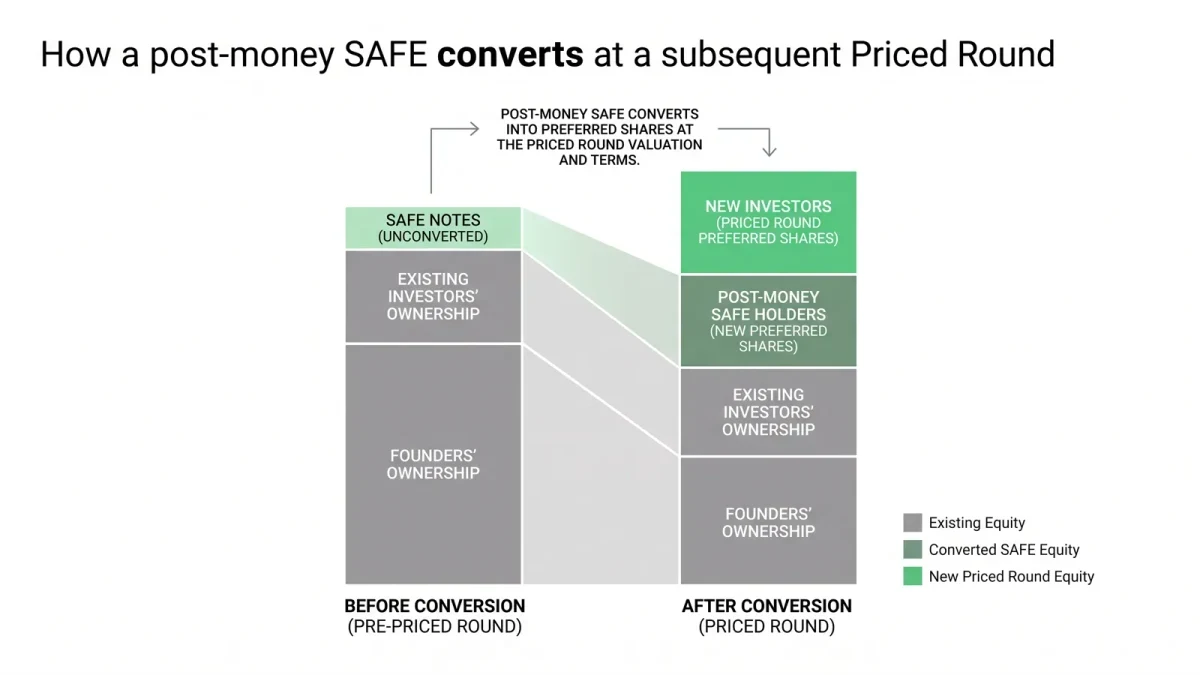
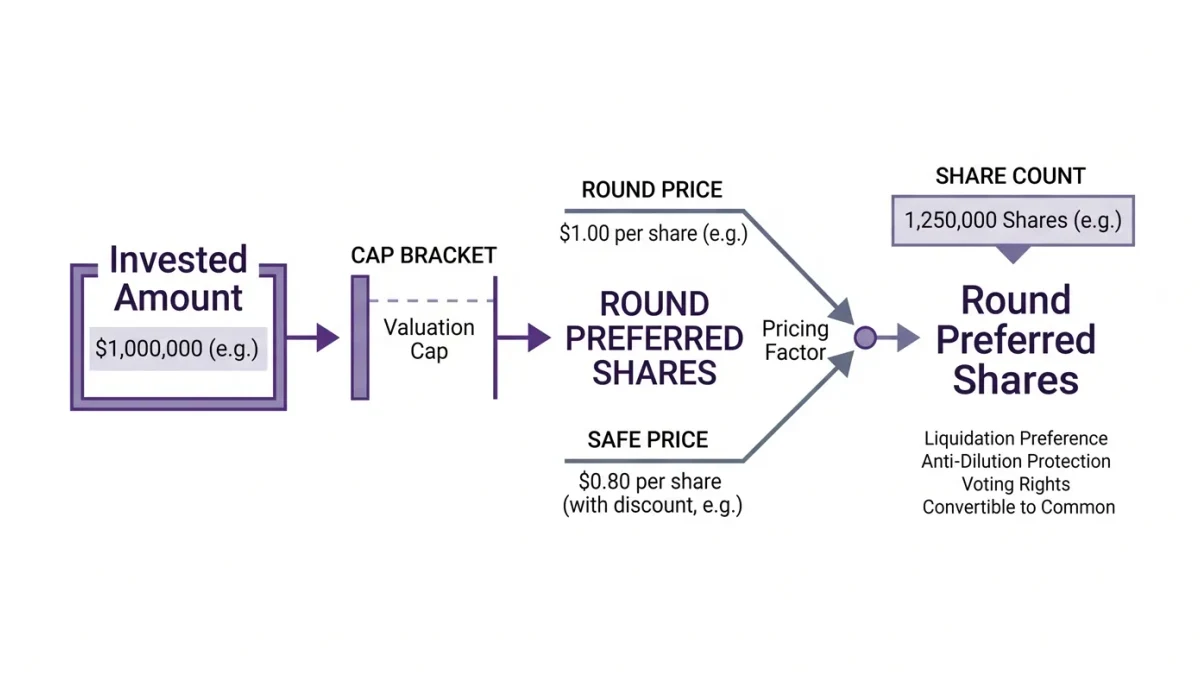
A SAFE converts at the next priced round in one of two flavors. With a valuation cap: the SAFE buys shares at the capped price however high the round prices — a $5 million cap on a company that later prices at $20 million means SAFE holders buy at a 75 percent discount. With a discount instead: typically 10 to 20 percent off the round price, whatever it is. Uncapped, no-discount SAFEs also exist — pure deferred risk, investor-favorable in the other direction. MFN ('most favored nation') clauses let early uncapped SAFEs adopt the terms of any better SAFE signed before conversion. The conversion math compounds: every SAFE's discount dilutes the round's investors, who respond by adjusting the price, which lands on the founders — the mechanism nobody watches until the stack is three layers deep.
What does the deferral actually cost?
The documented failure mode of the 2021-2022 vintage: companies stacked SAFEs at escalating caps — $10 million, $20 million, $40 million — and then the market repriced, the priced round landed at $25 million, and the SAFEs' conversion arithmetic consumed the round. Founders discovered that the effective valuation of their company was set not by the headline of the new round but by the stack beneath it; employees' option pool repriced downward; some rounds became impossible and became bridge extensions instead. The SAFE is cheap at signing and settles its bill at conversion, with interest — the interest being the uncertainty every later investor prices in when they see an unaudited stack.
What does a priced round buy for its cost?
For the legal spend — typically $30,000 to $100,000 across counsel at current rates — a priced round buys certainty: a valuation, a share price that sets the 409A and employee option strikes, a lead investor with a board seat and skin in the game, pro-rata rights that organize future financing, and a clean cap table that the next investor can read in an afternoon. It also buys friction: six to ten weeks instead of days, negotiation over protective provisions, and dilution crystallized at a moment the founders may consider the worst possible timing. The control terms — board composition, veto rights over future raises and sales — are the real transfer in a priced round, and the ones founders should negotiate hardest.
When is each instrument the right one?
The market's working answer: SAFEs for pre-seed and seed rounds below roughly $3 to $5 million, or between priced rounds when speed dominates — the canonical uses are a pre-seed from angels, a seed top-up, or an extension. Priced equity when a lead institution is taking a board seat, when the round is large enough that deferral risk compounds, or when the company needs the certainty — for an employee liquidity program, debt financing collateral, or an acquisition currency. The 2024-2025 market added a practical note: as round sizes inflated, the 'seed' label moved onto $5 million-plus raises, and more of those became priced rounds with SAFEs only for small early money — the instrument following the check size.
What should founders watch in SAFE terms?
Four terms decide everything: the cap (or its absence), the discount, the maturity — modern SAFEs have none, meaning no repayment obligation ever forces the issue — and the post-money versus pre-money framing. The post-money SAFE, Y Combinator's current standard, fixes the investor's ownership percentage at signing, which makes dilution from later SAFEs land entirely on the founders rather than being shared across the stack — a one-paragraph distinction worth real percentage points. Founders should model the full conversion waterfall before signing any SAFE: at three different next-round valuations, who owns what. The model takes an hour; skipping it has cost founders companies.
The choice is not speed versus rigor; it is which questions you answer now versus at conversion — and the interest rate on deferred questions is higher than founders expect.