A direct listing puts existing shares on an exchange without an underwritten offering: no new capital raised, no fixed offer price, no allocation to institutions — the market opens trading with an auction set by order flow. A traditional IPO sells new shares through bank syndicates at a negotiated price. The two paths differ on fees, certainty, lockups, and who the first shareholders are, and the choice is determined by what the company needs, not by which path is fashionable. Honey Badgers publishes information, not investment advice.
What are the actual cost differences?
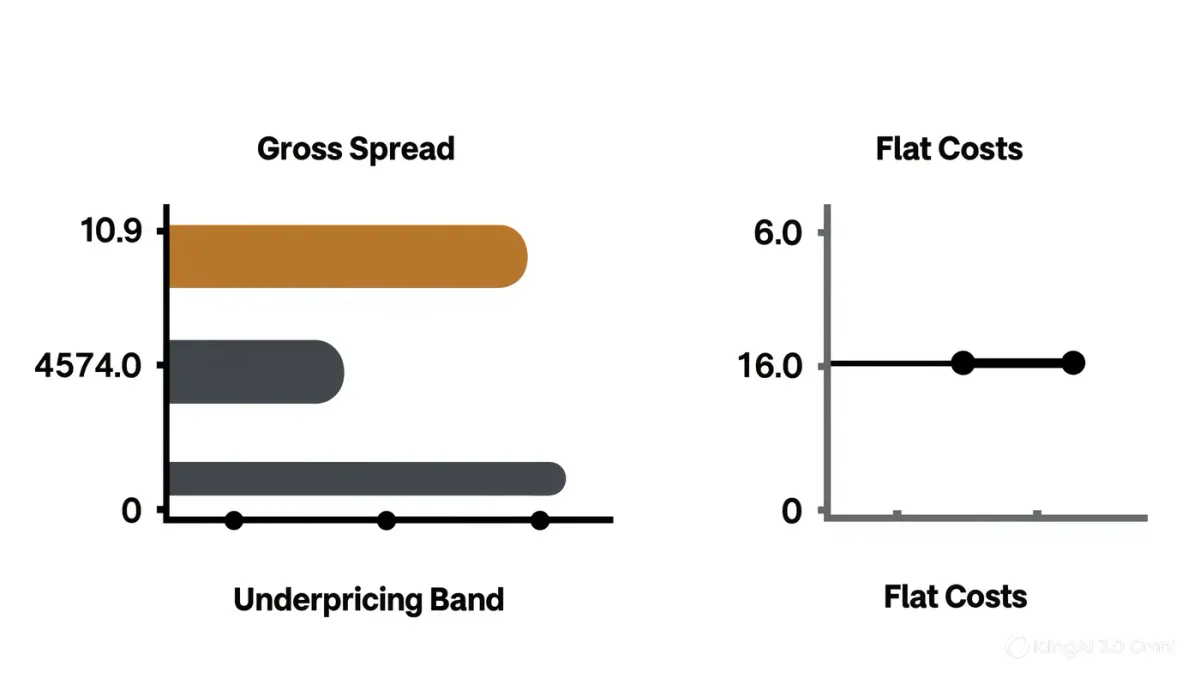
Gross spreads — the underwriters' fee on an IPO — run about 7 percent at deal sizes below $250 million and 3.5 to 5.5 percent on large tech IPOs, per filings and market data. On a $500 million raise, that is $20 to 25 million of fees, plus the underpricing itself: the first-day pop is a transfer to allocated institutions, frequently larger than the cash fee. A direct listing pays exchange listing fees, a financial adviser (typically a bank working for a flat retainer in the single-digit millions), and legal costs — materially cheaper, at the price of raising no money. Some issuers split the difference: Spotify and Slack listed directly in 2018 and 2019 raising nothing; the NYSE then won approval, and the SEC signed off, for direct listings with a primary raise — used rarely since, with the 2021 era's attempts (e.g., Squarespace considered; Coinbase listed via direct listing in 2021) spanning both forms.
What are the mechanics of each path?
In an IPO, the syndicate builds a book, prices the deal overnight, and allocates shares — the issuer knows its proceeds when it signs. In a direct listing, a market maker runs an opening auction from collected buy and sell interest; the opening price is where those curves cross, and early trading can be violent — Spotify's 2018 debut, the category's proof case, opened up sharply and settled; Coinbase's 2021 debut swung tens of billions in market cap within hours because no book had anchored placement. No lockup is required in a direct listing, though companies adopt voluntary ones — meaning employees and insiders can sell from day one, transferring the supply risk the IPO's lockup defers onto the opening auction.
Who has actually chosen each path?
The documented cases. Direct listings: Spotify (2018), Slack (2019), Palantir and Asana (2020), Coinbase (2021), and thereafter a trickle — the form has been rare since 2021's rate reset, because the companies for which it fits — cash-rich, brand-known, no primary need — have mostly been absorbed by private markets instead. IPOs: essentially everyone else, including the cash-rich — Stripe's contemplated listing is universally reported as a traditional IPO because employee liquidity at scale needs the underwriting machinery. The record's quiet conclusion: direct listing is a niche instrument for a specific company profile, not a movement.
How do the two paths compare on control and signaling?
Control: a direct listing involves no lead-left bank with aftermarket influence and no allocation politics; an IPO installs a stabilization agent whose research coverage and market-making matter for years — the lead bank is a long-term hire, not a toll. Signaling: pricing an IPO above a raised range is a marketing event a company can plan; a direct listing's open price is whatever the market says, with no narrative control on the day. For companies whose story needs explaining, the roadshow is not a cost — it is the product tour. For companies whose brand precedes them (Spotify, Coinbase), skipping it saved money and revealed price.
Which companies should choose which?
The decision matrix on the documented record. Choose a direct listing if: the company needs no primary capital; the brand is consumer-known enough that buyers arrive without a roadshow; insider supply is manageable and transparent; and volatility on debut is tolerable. Choose an IPO if: the company is raising money; institutional placement and aftermarket support matter; the story requires education; and certainty of proceeds — the priced deal — is worth the 7 percent and the pop. The 2025 window's evidence is unambiguous: Circle, Chime, Figma, Klarna — every major listing of the reopened window chose the underwritten path, because each needed cash or certainty or both, and the direct-listing alternative remained what it has been since 2021: available, cheap, and almost never chosen.
The toll booth is expensive, but it delivers passengers. The open road is free when your destination needs no cargo — and almost nobody's does.