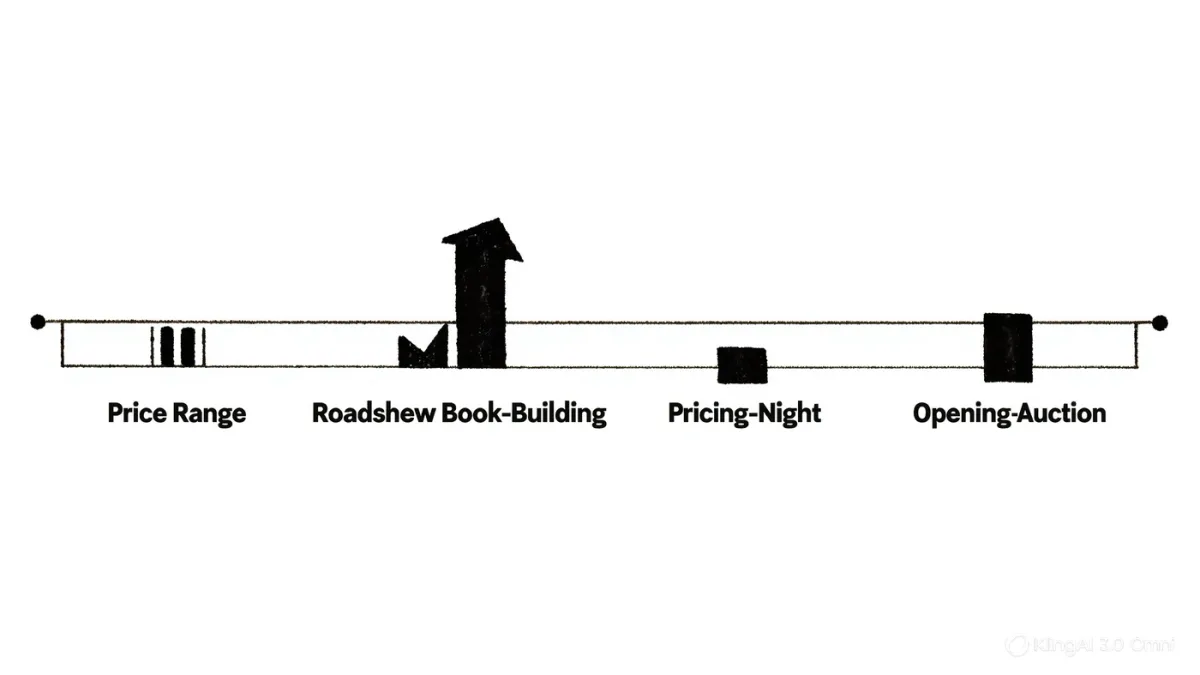
An initial public offering prices in two steps that most coverage collapses into one: the company and its underwriters set an offering price late the night before trading, and then the market sets a second, very different number when the stock opens hours later. Circle priced at $31 in June 2025 and opened near $69; Chime priced at $27 and opened around $40; Figma priced at $33 above a raised range and roughly doubled on debut. The process between the S-1 and the opening bell — roadshow, book-building, the pricing call, the opening auction — is machinery every founder and investor should understand before celebrating either number.
What happens between the filing and the range?
The S-1 filing goes to the SEC, which comments; the company amends. Weeks later, the underwriter syndicate — the banks led by one or two 'lead-left' bookrunners named on the filing's cover — publishes a price range, typically 20 to 25 percent below what insiders expect to achieve. The range is an anchor, not an appraisal: it is set low deliberately, because raising the range during the roadshow reads as momentum while cutting it reads as failure. Figma's July 2025 process was the textbook case: an initial range of $28 to $30 was raised to $32 to $34 mid-roadshow, and the deal still priced at $33 — a sequence designed to generate the upgrade headlines it generated.
What is the roadshow actually for?
For about ten days, management presents the same 30-to-60-minute pitch to institutional investors across cities, and the banks' sales desks collect indications of interest: how many shares, at what price, from whom. This is book-building. Indications are soft commitments — investors can reduce or walk — but by the end, the lead bookrunner knows roughly how many times oversubscribed the deal is at each price. A book that is five times covered at the top of the range gives the banks confidence to price at or above it; a book that barely covers the deal forces a price inside or below the range, or a postponement.
How is the final price actually set?
On pricing night, the lead underwriter brings a recommendation to a call with the company's board and executives, and the number is negotiated and approved — a decision made in hours, on the basis of the book's shape, comparable-company trading that day, and the general market tone for the next morning. The company signs the underwriting agreement, and the shares are sold to the institutions at that price. The money the company and selling stockholders receive is fixed at this point. Everything that happens on the exchange afterward — the pop, the fade, the volume — redistributes value among other people.
Why does the stock open somewhere else entirely?
The opening price on the exchange is set by an auction among buyers who did not get allocation or want more, run by the exchange's designated market maker with the lead banker's guidance. If the book was heavily oversubscribed and allocation was scarce, the first trade can gap far above the IPO price — Circle's 168 percent first-day close in 2025 being the extreme recent example. That gap is called money on the table: shares sold by the company at $31 that the market valued at $83 the same day. It is not a malfunction. It is the fee, in the form of a cheap allocation transferred to institutions, that companies pay for the underwriters' distribution certainty.
Who wins and who loses in the process?
The map of interests: the company wants maximum proceeds and a stable after-market; underwriters want a successful deal, a client for the aftermarket, and happy institutional buyers who get the discount embedded in underpricing; institutions want the allocation and the pop; selling insiders want price; employees with options want any price above their strikes. These interests conflict directly, and the pricing night decision balances them imperfectly. Founders should also understand greenshoe stabilization: underwriters typically sell 15 percent more shares than the base deal, with an option to cover the over-allocation at the IPO price — a mechanism that lets them support the stock in early trading without naked risk, and one that quietly enlarges the deal when the stock works.
What should a founder take from the machinery?
Three practical notes. Choose the lead-left bank for the aftermarket commitment and research coverage, not only the valuation promise — the range is negotiable, the six months after listing are the bank's real job. Model dilution and proceeds at the midpoint, not the top of the range, because pricing below range happens to good companies in bad weeks. And treat the first-day pop as a marketing event, not value creation: the money on the table left at Circle's pricing was real, and the beneficiaries were the allocation recipients, not the issuer.
The IPO is not one price but three — the range that anchors, the deal that funds, and the open that trades. Knowing who sets each, and for whom, is the difference between reading a debut and understanding one.