
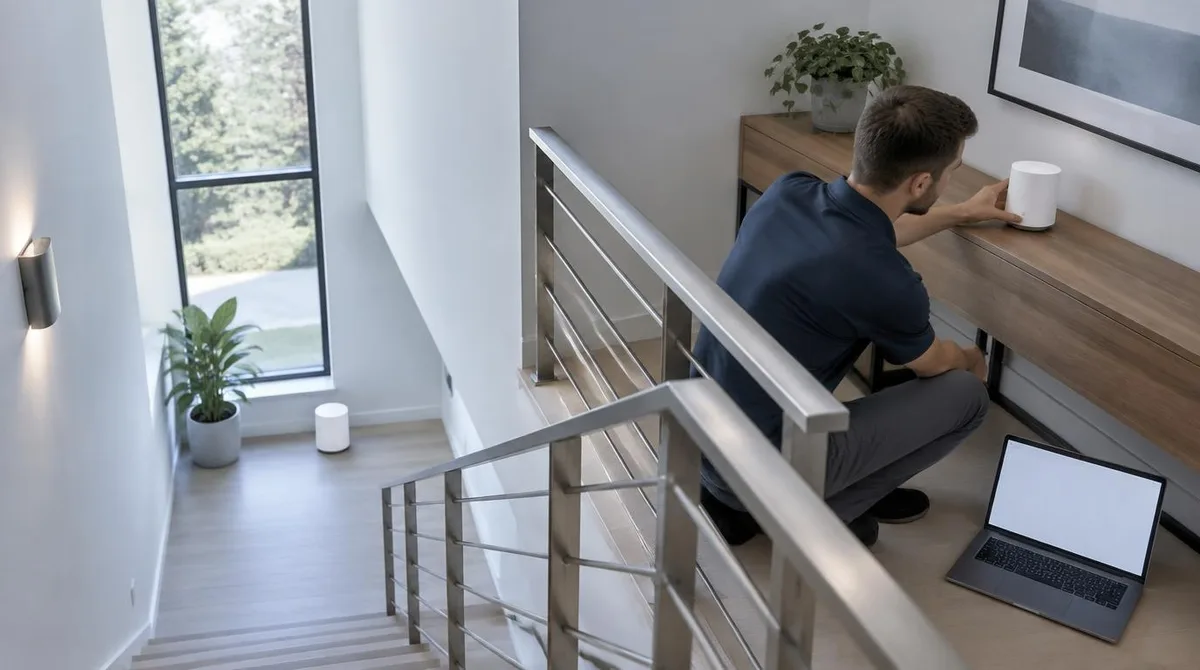
A single router is the wrong purchase for most big homes. If your house runs past 2,300 square feet or stacks more than two stories, the evidence from independent testers keeps landing in the same place: one box, however expensive, loses signal through walls and floors, and a mesh system of several access points holds coverage where a router fades. That is the verdict, and the testing behind it is more interesting than the spec sheets.
The honest headline number first. According to Wirecutter, the best standalone router it has tested is the TP-Link Archer BE230, a Wi-Fi 7 model that sells for around $130 and delivers the best mix of price, features and performance of any current router the outlet has evaluated. But Wirecutter's own guidance draws the boundary: its router picks suit apartments and small to medium houses, while larger homes should move to mesh.
Why spec sheets lie about coverage
Router marketing sells maximum speed at close range. Nobody streams a film standing next to the router. The number that actually decides whether your upstairs bedroom works is signal strength at distance, through walls, under load. That is a coverage question, not a bandwidth question, and coverage is measured, not printed on the box. Readers following this should also see How SAFE Notes Actually Work: Caps, Discounts, and the SEC Rules Founders Skip Past.
The strongest recent evidence on this comes from ZDNET's lab. According to ZDNET, its team tested 15 Wi-Fi 7 routers in a 12,500-square-foot lab, taking signal readings at 61 fixed numbered points with a site-survey tool, holding the layout constant across every unit so results stayed comparable. The point of the method is that it measures what a buyer actually experiences: signal at the far end of the building, not at the router's antenna.
What the lab data actually shows
The ZDNET results split by distance and interference bands rather than averaging everything together, which is the methodologically correct move. An average lets strong near-router readings mask weak far readings. Scored separately, the Netgear Nighthawk RS700S held the strongest signal in two of the three bands, staying in the "good" rating at medium and high distance-and-interference, which the outlet says is reliable for streaming, video calls and browsing. The Netgear Orbi 370 earned an "excellent" rating at the low band.
Worth noting what did not win: the Linksys Velop Micro 7 ranked last at both low and medium bands, and the Eero 7 did not lead at high distance. ZDNET is careful to say these routers may simply perform better on other frequency bands, such as 5 GHz or 6 GHz, since its testing covered only 2.4 GHz on a single floor. That caveat is the whole story of router testing in miniature. A single measurement setup is a slice of reality, and a different home can reorder the podium.
Mesh versus router: what the record supports
The structural argument for mesh is simple. A traditional router is one access point. Performance degrades as you add distance, walls and devices. A mesh system spreads several interconnected nodes around the house under one network name, so the access point is always near you. This connects to our earlier piece, OpenAI's Business Model Under Stress: What the Record Supports.
According to TechTimes, three-node mesh setups can blanket roughly 5,000 to 7,000 square feet with signal-mapping consistency of about 90% from basement to attic, while traditional routers drop to around 45% at the periphery through load-bearing walls. The same reporting puts traditional-router comfort zones at up to about 1,500 square feet, with multi-floor homes often seeing speeds of 150 Mbps or lower on upper levels. Those are the publication's mapped figures, not physics; your walls will have opinions. But the direction is consistent across every source in the record.
The trade is latency and peak speed. TechTimes' comparison has routers holding an edge at close range, around 8 milliseconds, versus a steady 12 to 15 milliseconds across mesh satellites. Near the router, a good standalone box wins. Across a whole multi-story house, mesh holds steadier. Big homes spend most of their time in the second scenario.
What this means for your floor plan
Practical steps, in order of evidence strength:
- Measure your square footage and story count honestly. Past 2,300 square feet or two stories, the record favors mesh over any single router, however expensive.
- If you are under that line, the best wifi router on the documented evidence is the TP-Link Archer BE230, Wirecutter's top pick at around $130. Wirecutter's pricing logic is worth stealing: quality does not scale with price, and a router with more antennas is not automatically better.
- If you go mesh, placement does real work. The TechTimes reporting recommends nodes 30 to 50 feet apart in central hallways, elevated rather than on the floor, away from microwaves and metal, and wired Ethernet backhaul where you can run cable, which reduces latency and recovers throughput that wireless backhaul loses.
- Do not buy an extender to patch a weak router. Wirecutter's rule of thumb is blunt: if you have considered adding an extender to an otherwise satisfactory router, buy a mesh system instead. Extenders are the worst of both worlds in the mapped data, with latency far worse than either option.
Our analysis: buy for the far room, not the near one
Reading the three sources together, the pattern is clear. Router reviews that test at 61 fixed points, or five laptops scattered through a real house, produce different winners than reviews that test throughput on a desk. Coverage-mapped testing is the method that matches how people live, and it consistently rewards either a modest, well-chosen router in a small space or a mesh system in a large one. The expensive middle ground, a flagship router stretched past its range, is the worst documented outcome.
One caution the record itself supplies. ZDNET tested one frequency band on one floor; TechTimes' figures come from its own comparison work; Wirecutter tests in one suburban house. None of these maps is your map. Treat the rankings as priors, not promises, and check the return policy before you commit. The audience walking out of the cinema is data, and so is the laptop that keeps dropping in the upstairs office.
What remains unknown is how these specific models behave across mixed bands and multiple floors, since no source in the record tested that combination. That gap matters most for buyers of the models that placed last in the ZDNET coverage test. The safe read is not that those routers are bad. It is that the evidence does not yet support them for the exact use case this article is about.