
Open source's traditional economics — volunteer communities, foundation stewardship, corporate sponsorship of shared infrastructure — assumed the valuable artifact was software that companies would jointly maintain. AI changed the artifact: a downloadable model is billions of dollars of compute crystallized into weights, and no foundation model of funding covers that bill. The documented record of 2024-2026 shows the replacement structures, and they are almost all corporate.
What broke in the old model?
Two documented breakages. First, the cost base: maintaining a Linux distribution is engineering time; training a frontier-adjacent model is eight to nine figures of compute. Sponsorship models that fund maintainers cannot fund training runs. Second, the free-rider scale: open-weights models are downloaded and served by commercial platforms whose revenue owes the releaser nothing — the extraction pattern familiar from open-source history (cloud providers commercializing community projects) repeated at model scale, but with the extraction powered by the releaser's own training spend. The existential version of the problem arrived for classic open source too: the 2024-2025 episodes of maintainers burning out or sabotaging their own packages — the xz backdoor attempt being the security wake-up call — documented that the volunteer layer underneath the software economy was underfunded at exactly the moment AI made it more load-bearing.
What replaced it for AI models?
Four documented structures. The corporate strategic release: Meta's Llama and Google's Gemma, open weights as competitive strategy — commoditize your rival's layer, funded from the balance sheet of a company monetizing something else. The commercial open-weights company: Mistral and DeepSeek's operator, releasing open weights while selling hosting, enterprise contracts, and API access — open as distribution for a services business. The hybrid license retreat: 'open' AI with usage restrictions — Llama's license conditions on the largest users — a category of its own that inherits neither community trust nor corporate freedom. And the foundation exception: genuinely community-governed open models exist (the Allen Institute's OLMo, EleutherAI's work) on philanthropic and government funding, and the record shows them chronically compute-constrained, a generation behind rather than months.
What happened to classic open-source companies?
The infrastructure layer beneath AI repriced. The 2023-2024 wave of license changes — HashiCorp's Terraform to BUSL, MongoDB and Elastic before — was the incumbents' defense against cloud providers monetizing their communities without contributing; the community forks (OpenTofu from Terraform) tested whether the ecosystem or the trademark held the value. In AI, the same drama ran bigger: when Meta restricted which companies could use Llama under export-control pressure in 2025, the ecosystem's dependence on a single corporation's strategy became a geopolitical variable. The documented lesson both times: whoever pays the training bill — or the maintainer bill — owns the project, whatever the license says.
How do projects actually get funded now?
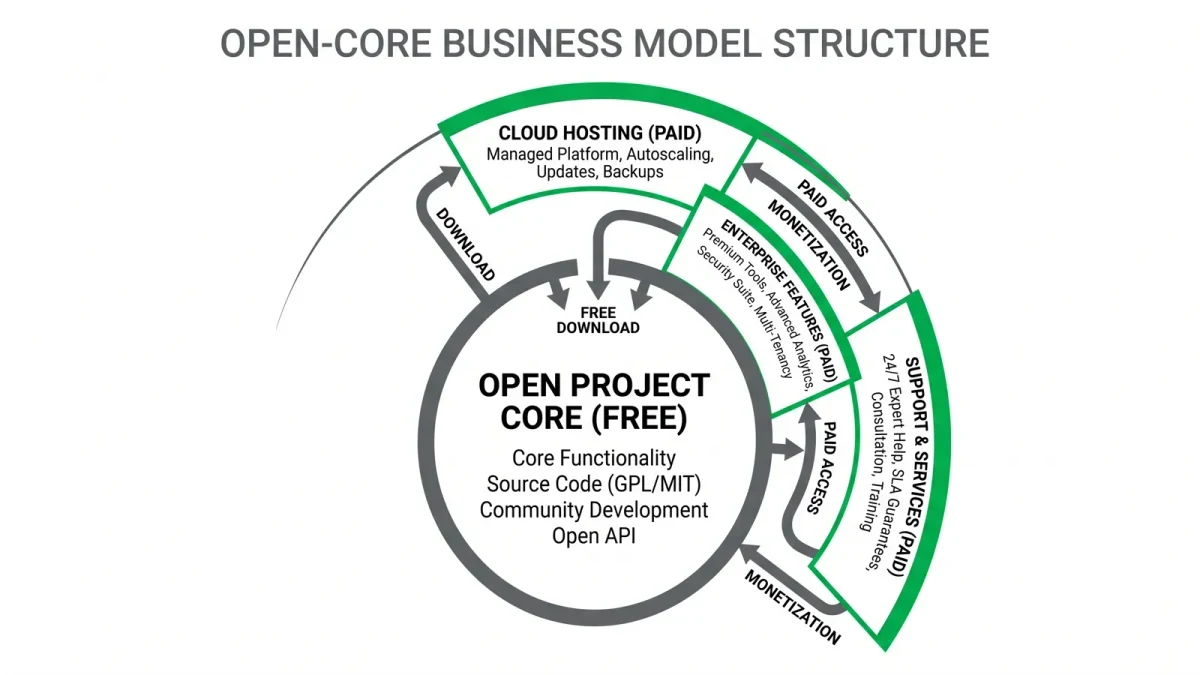
The working models on the 2025-2026 record. Open-core SaaS: the classic model, now covering AI tooling — the open project is the top of a commercial funnel, viable when the paid tier is infrastructure-adjacent (hosting, governance, scale). Corporate employment of maintainers: the quiet workhorse — critical libraries funded as line items on big-tech and lab engineering budgets, with the fragility that the funding follows strategy, not criticality. Venture-funded open source: the Red Hat playbook's descendants, now with AI variants — raise capital on adoption metrics, convert to services and enterprise; the documented 2024-2025 correction sorted the cohort, and the survivors monetized the operations layer (deployment, evaluation, compliance) rather than the artifact. And AI-assisted maintenance: labs funding and tooling the maintenance of the open dependency tree their models trained on — the self-interested repair of the commons, early but real.
What should builders take from the record?
Three practical rules. Fund the artifact, not the license: open-weights releasers are strategy or services businesses, and building on their releases means inheriting their strategy — check who pays the training bills and what happens to your dependency when the payer's priorities move. For maintainers: employment and open-core remain the only documented sustainable models; sponsorship funds recognition, not careers. And for startups choosing what to open: the record rewards open-sourcing the layer you want commoditized and selling the layer above it — the single consistent economic logic in every structure above.
Open source did not die in the AI era; it got a business model transplant. The community flags still fly over projects whose training runs, licenses, and roadmaps are paid for by companies — and the honest reading of the record is that this is not a phase but the new equilibrium.