The AI industry split into two business models — closed labs selling access to frontier models, and open-weights releasers publishing downloadable parameters — and by 2025 the debate between them had become a numbers question: capability gaps measured in months, training costs measured in hundreds of millions, and inference margins measured at zero. This analysis reads the documented record: model releases, published benchmarks, revenue reporting, and regulatory filings.
What does 'open weights' actually mean?
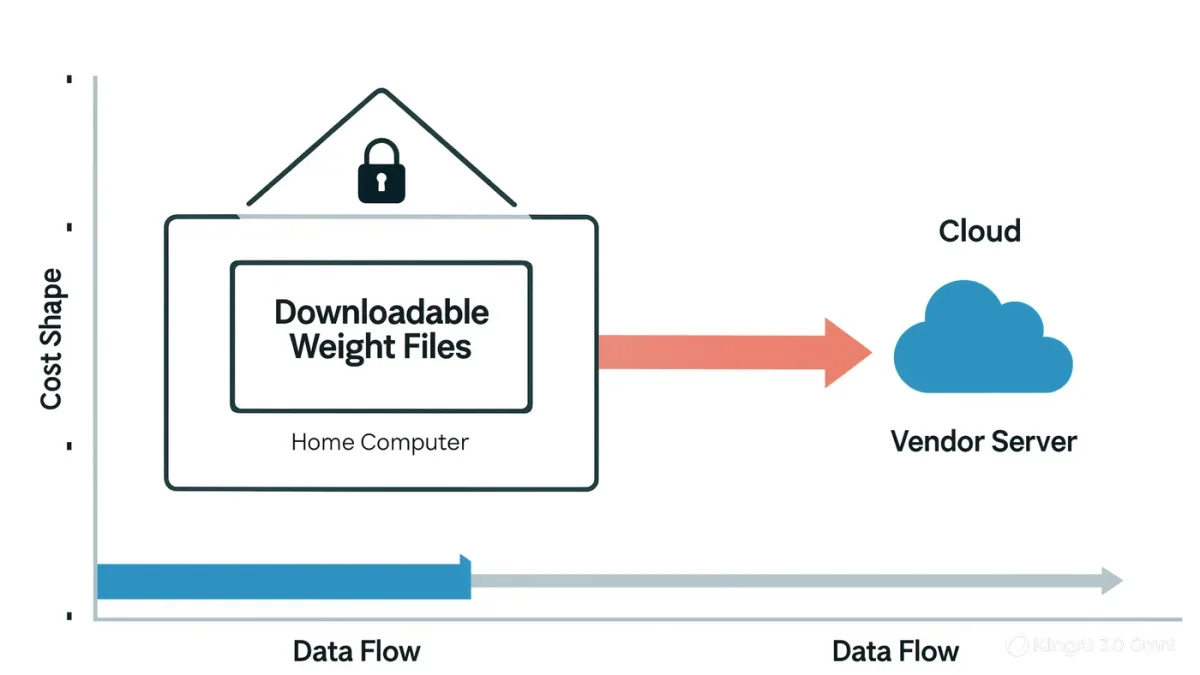
Open weights means the trained model parameters are downloadable, so anyone can run the model on their own hardware and fine-tune it — distinguished from open source, since training data and code are usually not released. Meta's Llama family defined the category from 2023, with usage-restricted licenses; DeepSeek's R1 release in January 2025, under a permissive MIT license and with published training methodology, moved the frontier-performance line into open weights and shifted the policy debate in Washington overnight. Mistral in Europe and Google's Gemma series (open alongside its closed Gemini line) round out the major releasers.
How big is the capability gap now?
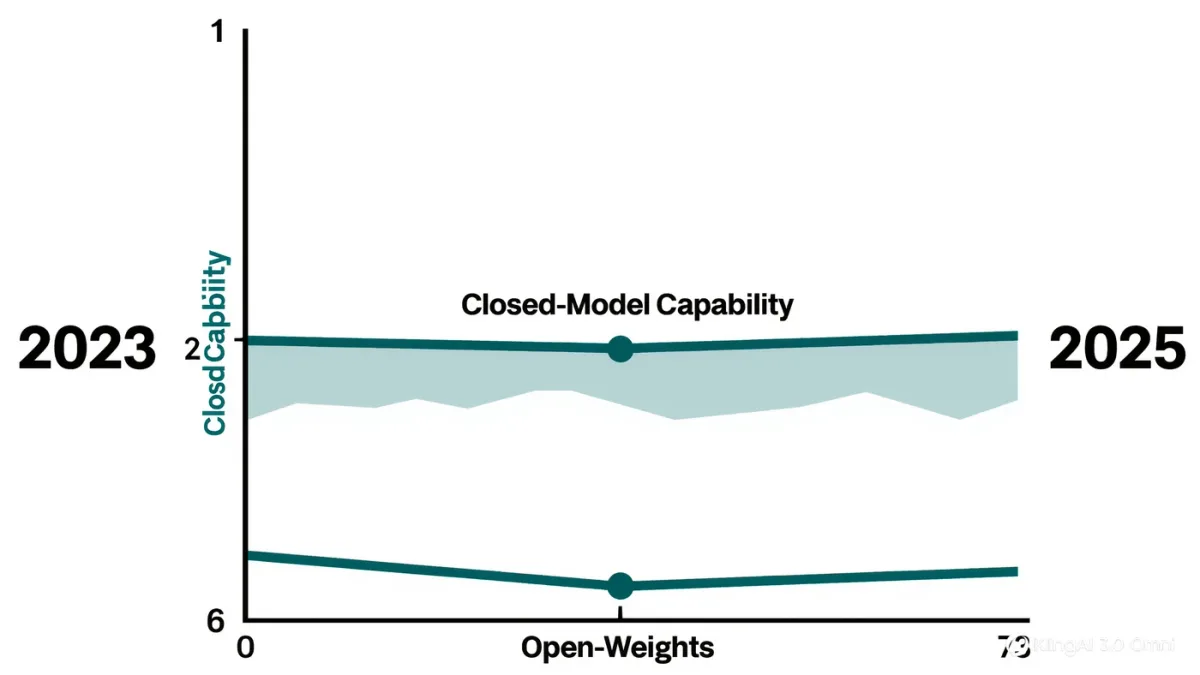
The documented pattern across benchmark releases: open-weights models have trailed the closed frontier — OpenAI, Google DeepMind, and Anthropic's best — by a margin that compressed from roughly a year in 2023 to a few months by 2025, per contemporaneous benchmark comparisons at each release. The closed labs retain leads at the very top on reasoning-dense tasks, and the practical significance depends on the use: for most enterprise workloads, the open models within months of frontier run at a fraction of the cost, which is why cloud providers' catalogs filled with tuned variants. The gap that matters commercially is no longer capability but reliability at the newest capability — and that gap is what the frontier labs now sell.
What are the economics of each camp?
Closed: enormous training spend — reported figures for frontier runs run into hundreds of millions of dollars each — recovered through API pricing and subscriptions, with margins defended by inference-efficiency gains that labs claim are rapid but never audit publicly. Anthropic's reported annualized revenue run-rate above $5 billion by late 2025, and OpenAI's above $10 billion, are the closed model's proof of monetization. Open: the releasers don't sell the model; they monetize adjacency — Meta used Llama to commoditize the layer its ad business depends on; Mistral sells enterprise deployment and hosting of its open and commercial models; DeepSeek's operator monetizes via API at prices that reset the market downward. Open weights are a strategy, not a charity.
What did DeepSeek actually change?
Two documented shocks in January 2025. First, the R1 model demonstrated reasoning performance near closed frontier level from a Chinese lab under export controls on top-tier chips. Second, the published training cost claim — under $6 million of compute for the final training run, company-claimed, widely interpreted with caveats since it excluded prior research and infrastructure — became a market event, contributing to the single-day selloff in AI-linked equities on January 27, 2025, when Nvidia lost roughly $600 billion of market value in a day. The claim's precise truth matters less than the demonstration: near-frontier capability was achievable at costs far below the frontier labs' spend, which compressed API pricing market-wide and forced every closed lab to defend its price umbrella.
What are the risks each camp carries?
Closed-model risks: pricing power erosion from below as open weights catch up in months, regulatory attention to concentration, and trust questions from enterprise buyers who cannot audit the model they depend on. Open-weights risks: safety governance of downloadable systems with no kill switch — the EU AI Act's August 2025 GPAI obligations require documentation and systemic-risk assessment from providers including open releasers; misuse documented across 2025 from cheap open models powering influence operations and cyber tooling, per security-vendor reporting; and the free-rider problem, where the ecosystem monetizing open weights owes nothing back to the releaser. Both camps' risks are now written into policy rather than hypothetical.
Where does this leave startups building on models?
Practical guidance from the documented economics: the model layer is commoditizing from below at predictable speed, so value migrates to proprietary data, workflow integration, and distribution; infrastructure choices should price in the open-weights option — running capable open models on owned hardware is the hedge against closed-API pricing and policy shifts; and any moat that assumes a permanent capability gap is a moat the 2025 record has already repriced. The debate is no longer ideological. It is a build-versus-buy calculation with published numbers on both sides.
The numbers say: closed leads by months, open prices at a fraction, and every quarter narrows one while extending the other's catalog. Founders should plan for both to remain true.