
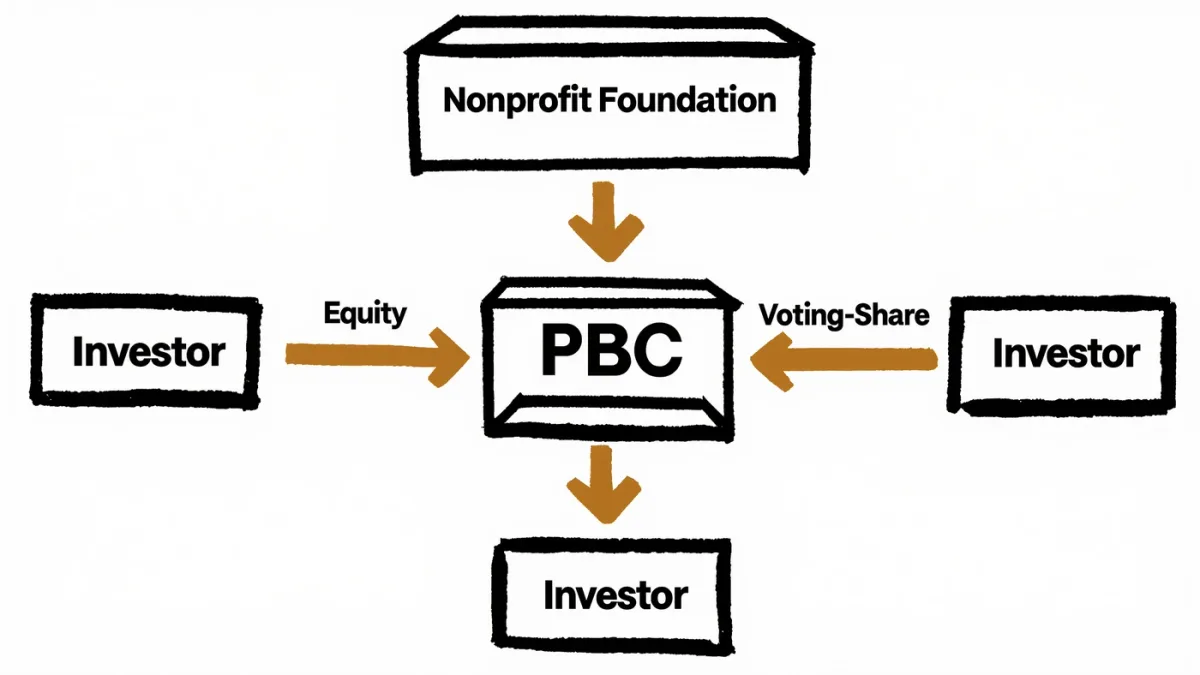
OpenAI's restructuring, completed October 28, 2025, moved its commercial operations into OpenAI Group PBC, a Delaware public benefit corporation, ending the nonprofit's direct control of the business while leaving the nonprofit as a major shareholder with mission obligations. The conversion — announced March 31, 2025 and contested in court by Elon Musk along the way — is the most consequential governance event in the modern tech industry, and its mechanics matter to every startup weighing mission language against growth capital. Honey Badgers publishes information, not legal advice.
What was wrong with the old structure?
OpenAI began in 2015 as a nonprofit with a capped-profit subsidiary added in 2019 — a design meant to keep AGI development safe from profit pressure, but one that made it nearly impossible to raise the hundreds of billions the compute race demanded. Investors in a capped-profit vehicle face a ceiling on returns; lenders and sovereign funds hesitate at nonprofit boards' power to replace leadership, a power exercised memorably in November 2023 when the board removed Sam Altman, then reinstated him within days under investor pressure. The March 2025 announcement of a for-profit conversion was the direct consequence: capital needs had outgrown the structure.
What is a public benefit corporation, exactly?
A PBC is a for-profit corporation whose charter obliges its board to balance shareholder returns against a stated public benefit — for OpenAI, the safe development of artificial general intelligence. Delaware PBC law gives directors legal cover to consider mission consequences, not only fiduciary value maximization. What a PBC is not: a charity, a nonprofit, or a company anyone controls for free. It pays taxes, sells equity, and can go public — flexibility the old structure lacked.
Who actually controls OpenAI now?
Per the company's published summary of the completed structure: the nonprofit OpenAI Foundation holds equity in the PBC — a stake reported around 26 percent — plus a voting position through a class of non-transferable voting shares, allowing it to block major decisions like a sale of the company or the removal of mission language. Microsoft holds a large minority stake reported around 27 percent with corresponding economic interest; SoftBank invested $7.5 billion at the closing's $500 billion valuation as part of its earlier round agreements; employees and other investors hold the rest. The foundation's mission obligations remain: the PBC must pursue its stated benefit purpose, and the nonprofit's charter-derived leverage — the voting block — is the enforcement mechanism.
What did the conversion settle legally?
Two fights ended in the structure. The Musk litigation — which sought to block the conversion as a betrayal of the founding mission — settled in mid-2025 with Musk withdrawing his California state claims after OpenAI agreed to fund his charitable trust, and a federal judge had earlier declined to halt the restructuring. The Washington state attorney general's inquiry into whether the nonprofit's assets were being fairly valued concluded in late 2025 with the office accepting the structure after OpenAI increased the nonprofit's stake. Both outcomes are documented; neither is a judicial blessing of every term.
Why does this matter for startups and founders?
Three takeaways for anyone building. First, mission governance is now a financing instrument: the PBC form let OpenAI keep mission language while unlocking capital — a path any mission-driven startup can use at small scale. Second, control is negotiated through share classes, not statements: the nonprofit's voting block, not its values, is what constrains the PBC. Third, restructures get litigated: the conversion consumed two years and eight figures of legal spend, and founders who promise governance structures to early stakeholders should price in the cost of changing them later.
What remains unresolved?
On the record: the exact economic split among stakeholders is only partially disclosed; the nonprofit's ongoing funding commitments are published in outline, not line items; and whether a public offering of the PBC occurs — now structurally possible — is an open question that the company has said would be decided by its board, not by announcements. The mission enforcement question, the one Musk's lawsuit raised, is now a shareholder-mechanics question, and the mechanics are only as strong as the voting block behind them.
The restructure worked as engineering: capital now flows, mission language survived, litigation settled. Whether it worked as governance is a question the next crisis will answer — and on that, the record is properly silent.